

Received ₹10 Lakh as a Bonus? How Should You Invest It?
Received a ₹10 lakh bonus? Learn how to decide between spending, debt repayment, near-te...
28 September 2026
Last reviewed: June 2026 | Rates updated for Q4 FY2025‑26
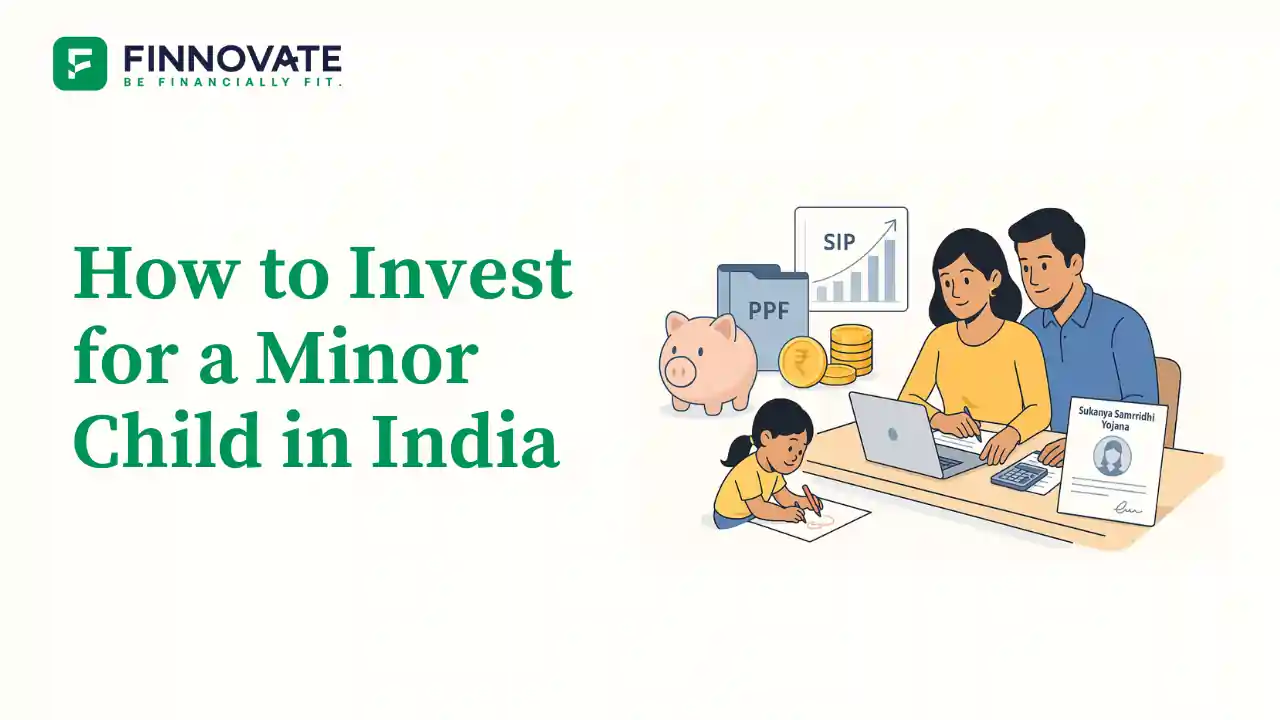
Every parent wants to give their child a strong start. The best education, the freedom to choose a career without financial pressure, a head start in life. That intention is rarely the problem. What gets in the way is time: the years pass, costs rise faster than most families expect, and what seemed like a future concern becomes an urgent one.
This guide covers every major child investment option available in India in 2026, including what changed after SEBI's February 2026 mutual fund circular. Current rates, tax rules, how to invest in a minor's name, and a clear framework to match the right product to the right goal.
Use Finnovate's Child Education Plan Calculator to estimate how much you may need for your child's future education goals.
The table below covers the main options parents consider. It is an orientation tool, not a recommendation. Market-linked products carry variable returns; rates cited are current as of Q4 FY2025‑26.
| Product | Type | Rate / Return | Tax benefit | Lock-in | Best suited for |
|---|---|---|---|---|---|
| PPF (minor account) | Government savings | 7.1% p.a. | EEE, fully tax-free | 15 years | Long-term stability, any child |
| SSY | Government savings | 8.2% p.a. | EEE, fully tax-free | 21 years from opening | Girl child, long-term education or marriage goal |
| Equity MF SIP | Market-linked | Variable | LTCG at 12.5% above Rs 1.25L | None (flexible) | Long-term goals 10+ years away |
| Life Cycle Funds (new SEBI category, 2026) | Market-linked, glide path | Variable, shifts equity to debt over time | LTCG at 12.5% above Rs 1.25L | 5 to 30 years (target maturity) | Goal-based long-term investing; replaces children's fund category |
| NPS Vatsalya | Government pension | Market-linked | 80C + 80CCD(1B) for guardian | Converts to NPS at 18 | Long-horizon retirement head start |
| Fixed Deposit | Fixed-income | 6.5‑7.25% p.a. | Interest taxable at slab rate | Varies by tenure | Short-term goals, capital protection |
| Gold ETF / Gold Fund | Commodity | Market-linked | LTCG at 12.5% after 24 months | None | Small diversification allocation only |
You do not always need to invest in your child's name to build for their future.
Many parents assume that if the goal is for the child, the investment must also be in the child's name. That is not always the case. In many situations, investing in a parent's own name and earmarking that portfolio for a child-related goal is simpler, more flexible, and easier to manage.
There are situations where investing in the minor's name makes specific sense. Sukanya Samriddhi Yojana requires the account to be in the girl child's name, and some parents prefer a clearly separated goal-based corpus. But the question of whose name is a logistics question, not a performance question.
The better starting point is: which route serves this specific goal most efficiently? Investing in the minor's name or in the parent's name each has different implications for flexibility, taxation, and operational management.
In India, a person below 18 years of age is a minor under the Indian Majority Act, 1875. Since a minor cannot legally enter into contracts or operate most financial accounts independently, the parent or legal guardian opens and operates the account on the child's behalf.
Three things follow from this directly.
For most minor investments, the guardian's KYC, PAN, and bank details are central to the process. In mutual fund folios, the guardian operates the folio with the minor as the sole holder. Joint holding between a minor and another person is not permitted in minor MF folios.
Income from a minor child's investments is generally clubbed with the income of the parent whose total income is higher, under Section 64(1A) of the Income Tax Act. This applies to interest income, dividend income, and capital gains from investments held in the minor's name.
When the child becomes a major, the status of every account held in the minor's name must be updated. In mutual fund folios, this involves fresh KYC, updated bank details, and re-registration of mandates. Transactions may be restricted until the update is completed. Planning this transition in advance avoids disruption at the time of redemption.
SSY is a dedicated long-term government savings scheme for the girl child, introduced under the Beti Bachao Beti Padhao initiative.
Key facts as of Q4 FY2025‑26:
One operational detail many parents miss: maturity is 21 years from the date the account was opened. Opening the account early maximises the deposit period and the compounding runway.
SSY vs equity MF SIP: a brief comparison
| SSY | Equity MF SIP | |
|---|---|---|
| Return | 8.2% p.a. fixed (subject to quarterly revision) | Market-linked, variable. Historically higher over 15+ year periods; not guaranteed. |
| Tax | EEE, fully tax-free | LTCG at 12.5% on gains above Rs 1.25L per year after 1 year |
| Flexibility | Deposits for 15 years, limited withdrawal | Start, stop, step up, redeem anytime (children's MF has lock-in) |
| Liquidity | Low. Partial withdrawal only after age 18. | High for regular MF; 5 years or age 18 for children's MF category |
| Suitable for | Conservative families, stable guaranteed base | Growth-oriented families comfortable with market fluctuation |
PPF remains one of the most straightforward long-term government-backed savings options available to Indian families.
Key facts as of Q4 FY2025‑26:
One detail specific to minor PPF accounts: the Rs 1.5 lakh annual deposit cap applies per individual account. A parent who holds their own PPF account and opens a separate one for their minor child should be aware that both accounts are linked under the same PAN ecosystem. Staying within the combined limits matters for tax planning. Consulting a CA on this before opening is advisable.
For goals that are 10 or more years away, equity mutual fund SIPs are among the most widely used vehicles for building a long-term child corpus. Regular investing through a SIP benefits from rupee-cost averaging, and a longer time horizon reduces the impact of short-term market volatility.
Choosing a fund category by goal horizon:
Switching from equity to lower-risk categories as the goal approaches is standard practice in goal-based financial planning. Leaving 100% in equity for a goal that is 2 years away creates unnecessary timing risk.
Note: SEBI discontinued the dedicated "children's fund" solution-oriented category in February 2026. The replacement is Life Cycle Funds, a new SEBI-defined category with a target maturity date and glide path. Details are covered in the mutual funds section below. For how capital gains tax applies to equity and hybrid mutual fund redemptions: Mutual fund taxation in India (FY 2025‑26).
Estimating your target corpus
Use Finnovate's Child Education Plan Calculator to estimate your target corpus and work backwards to an appropriate monthly SIP amount based on your timeline and goal.
In February 2026, SEBI made a significant regulatory change affecting how parents invest in mutual funds for child goals. Via a circular dated February 26, 2026, SEBI discontinued the "solution-oriented schemes" category, which previously included dedicated Children's Funds and Retirement Funds. Existing schemes in this category were directed to stop accepting fresh subscriptions with immediate effect. These schemes are in the process of being merged into other schemes with similar asset allocation profiles, subject to SEBI's approval.
Why SEBI discontinued it: SEBI's assessment was that the portfolios of children's funds and retirement funds largely overlapped with regular equity or hybrid funds, making the category less meaningful for investors. The "solution-oriented" label was providing a branding distinction without a genuinely differentiated investment mandate.
What replaces it: SEBI has introduced a new category called Life Cycle Funds. These are open-ended schemes with a defined target maturity and a built-in glide path, meaning the asset allocation automatically shifts from higher equity exposure to lower equity (more debt) as the fund approaches its maturity date.
Key features of Life Cycle Funds (per SEBI circular, February 26, 2026):
What this means for the SIP-based approach: The underlying logic of using mutual fund SIPs for long-term child goals remains entirely sound. SEBI's change is a category restructuring, not a commentary on whether mutual funds are appropriate for child investment goals. Regular diversified equity or hybrid SIPs, matched to the goal timeline, continue to be a practical growth vehicle for parents. Finnovate's Life Cycle Fund explainer covers the full regulatory detail: SEBI's new Life Cycle Mutual Funds explained.
NPS Vatsalya was launched on 18 September 2024 under the Union Budget 2024‑25. It is regulated by PFRDA and extends the National Pension System to minor children.
Key facts:
NPS Vatsalya makes sense for parents who want to give their child a long-term pension head start alongside a separate education corpus. It is not a substitute for an education fund.
FDs and RDs serve a specific function in child investment planning: capital safety for short to medium-term goals. Major bank FDs are currently offering 6.5‑7.25% per year for 1‑3 year tenors (Q4 FY2026). Interest earned is taxable at the guardian's applicable slab rate.
Where FDs work well:
FDs are not the right primary vehicle for a 15-year education corpus. At 6.5‑7% before tax, returns are likely to lag private education cost increases over longer periods.
Gold has historically acted as an inflation hedge and portfolio diversifier. It should not be the primary vehicle for an education corpus.
If gold is part of the plan, digital formats are more practical than physical gold:
If gold is included at all, keeping it to 5‑10% of the child investment portfolio allows diversification without making the corpus dependent on commodity price movements. For how gold ETFs, gold funds, and SGBs are taxed: Taxation of gold in India explained.
The SIP versus lump sum question is primarily a logistics question, not a performance question. Over long periods in equity, regular SIPs and lump sum investments tend to produce comparable outcomes.
| SIP | Lump sum | |
|---|---|---|
| Best for | Salaried parents with regular monthly income | Windfall income: bonus, gift, inheritance |
| Minimum investment | As low as Rs 500/month for most MF categories | Varies by product: Rs 500 for PPF, Rs 250 for SSY, Rs 5,000+ for most MF lump sums |
| Discipline mechanism | Auto-debit enforces regularity | Requires deliberate annual decision to deposit |
| Market timing risk | Largely eliminated through rupee-cost averaging | Higher if invested as a single amount at a market peak |
| Flexibility | Start, stop, step up anytime | Annual deposit decision applies for PPF and SSY |
For most salaried families, SIPs are the more practical route. For parents who receive annual bonuses or one-time gifts from grandparents, deploying that amount as a lump sum into PPF, SSY, or a children's MF can complement a regular SIP running in parallel.
The right product mix depends on the goal, the timeline, and the family's risk comfort. The framework below reflects general product characteristics, not a personalised recommendation.
| Goal | Timeline | What tends to suit this goal | Why |
|---|---|---|---|
| Higher education (college) | 15+ years away | Equity MF SIP as primary growth vehicle; PPF or SSY as stability base | Long runway allows equity volatility to be absorbed; government-backed options provide a guaranteed floor |
| Higher education (college) | 8‑12 years away | Hybrid MF SIP as primary; gradual shift toward debt categories in the final 3-4 years | Shorter runway reduces tolerance for equity volatility near the goal date |
| Marriage or long-term wealth | 18‑20 years away | Equity MF SIP for growth; SSY for a girl child as additional base | Very long horizon suits equity; SSY matures at 21 years from opening, aligning with this timeline |
| School fees or near-term expenses | Under 3 years | Fixed deposits or debt-oriented MF categories | Capital protection matters more than growth for a near-term goal |
The goal determines everything else. Before selecting any product, clarify: what is the goal, when will the money be needed, what form will it take (lump sum or staged payments), and what is the family's risk comfort level.
Finnovate's Child Education Plan Calculator can help estimate the target corpus for an education goal, accounting for the number of years to the goal.
A general rule of thumb:
For most minor investments, the following are typically required:
Key operational points:
Both can be opened at any branch of an authorised bank or India Post. Online options are available at most major banks. For SSY, the girl child must be below age 10 at the time of opening. For PPF, there is no age restriction on opening a minor's account.
Income from investments held in a minor's name, including interest, dividends, and capital gains, is generally clubbed with the income of the parent whose total income is higher, under Section 64(1A) of the Income Tax Act.
Investing in a minor's name does not reduce overall family tax liability in most cases. Parents who assume this is a tax-saving strategy may be surprised at ITR filing time. Planning with a CA ahead of any significant investment in a minor's name is advisable. For a full breakdown of how capital gains tax applies to mutual funds, gold, and other investments: Capital gains tax in India (FY 2025‑26).
Once the minor turns 18 and the records are properly updated, future income and gains from those investments are taxed in the child's own hands based on the applicable tax rules for each product.
This step is operational and time-sensitive. Missing it can restrict account transactions at the moment they are most needed. Start this process at least 2‑3 months before the child turns 18.
Thinking in buckets is a practical way to structure a child investment portfolio without overcomplicating it.
Bucket 1, Safety base: PPF or SSY (for a girl child). Government-backed, low-risk, tax-efficient. Builds slowly but reliably.
Bucket 2, Growth engine: equity or hybrid MF SIPs. Takes the bulk of the monthly investment for long-horizon goals. Absorbs market volatility over a long timeline.
Bucket 3, Near-goal protection: as the goal approaches within 3‑5 years, move a portion of the equity corpus to lower-risk products such as debt funds, FDs, or liquid funds. This protects gains from a market correction at a critical time.
For parents who want to give their child a long-term pension foundation alongside the education corpus, NPS Vatsalya can serve as an optional fourth vehicle. It is separate from all three buckets above and suited to a very long time horizon.
Planning your child's financial future is more than choosing a product.
It involves aligning the child's goals with the family's overall financial picture, including existing investments, insurance, emergency fund, and retirement planning. Book a free call with Finnovate's advisers to build a plan that works across all these dimensions together.
Starting early matters more than starting with a large amount. The compounding advantage of beginning a Rs 3,000 monthly SIP at birth versus starting at age 5 is substantial. The difference comes from the additional years in the market, not from investing a larger amount.
Start with the right number first.
Use Finnovate's Child Education Plan Calculator to see how much you may need and what it takes to get there.
Yes. A mutual fund folio can be opened in the name of a minor, with the parent or legal guardian operating the account. The minor is the sole holder, and joint holding is not permitted. The guardian handles all transactions until the child turns 18, at which point a change-of-status update is required.
They serve different purposes. PPF offers a government-backed return with full EEE tax treatment as a low-risk base, while equity mutual funds are market-linked and have historically provided higher returns over long periods. The right choice depends on the goal timeline and the family's risk comfort.
SSY currently offers a higher rate than PPF (8.2% vs 7.1% as of Q4 FY2025‑26) with the same EEE tax status, but is available only for a girl child below age 10 at account opening. SSY has a longer lock-in (21 years from account opening) and less flexibility than PPF. For a girl child, SSY is generally stronger on rate; PPF offers more flexibility and is available for any child.
PPF and SSY (for a girl child) can be opened from birth, giving the maximum compounding runway. Equity mutual fund SIPs in a minor folio can also be started from birth, and the longer the runway, the more compounding works in the family's favour. Please consult a SEBI-registered investment adviser before making investment decisions.
NPS Vatsalya is a pension scheme for minors, launched in September 2024 and regulated by PFRDA. Contributions are made by the guardian until the child turns 18, after which the account converts to a standard NPS Tier-I account with standard NPS withdrawal norms applying. It is a retirement vehicle, not an education corpus, and is best treated as a separate long-horizon contribution rather than a substitute for an education fund.
Yes. A mutual fund folio can be opened in a minor's name, with the parent or guardian as the sole operator. All transactions are handled by the guardian until the child turns 18, at which point a change-of-status update is required before further transactions can be processed. Please consult a SEBI-registered investment adviser before selecting specific fund categories.
The Sukanya Samriddhi Yojana interest rate for Q4 FY2025‑26 (January to March 2026) is 8.2% per annum, compounded annually. Rates are reviewed and announced by the government each quarter. Parents should check the NSI India website (nsiindia.gov.in) for the most current quarter's rate before making deposit decisions.
A demat account can be opened in a minor's name and operated by a guardian. For most parents, a mutual fund SIP route is more practical given lower operational complexity and the built-in investment discipline. A minor demat account makes more sense for experienced investors with a specific rationale for direct equity exposure in the minor's name.
There is no universal answer. The right figure depends on the target course, expected future costs, the years remaining, and the expected return from the chosen investment mix. Use Finnovate's Child Education Plan Calculator to estimate the right monthly amount for your specific goal and timeline.
PPF allows a lump sum deposit of up to Rs 1.5 lakh per year in a minor's account with full EEE tax treatment, making it the most tax-efficient one-time option. For a girl child, SSY accepts the same Rs 1.5 lakh annual limit as a single deposit. For goals 10 or more years away, a lump sum into an equity mutual fund in the minor's folio is also commonly used, though returns are market-linked and not guaranteed. Please consult a SEBI-registered investment adviser before making any investment decision.
SEBI's circular dated February 26, 2026 discontinued the solution-oriented schemes category, which included children's funds. Existing schemes stopped accepting fresh subscriptions and are being merged into other schemes with similar asset allocation profiles. Your AMC is required to inform you of the merger plan and exit window before the merger is executed. Check your registered email for AMC communication and review the proposed merger scheme before deciding whether to continue, switch, or redeem.
No. A minor below 18 cannot independently open a mutual fund folio, demat account, or bank account in India. All investments in a minor's name are operated by a parent or legal guardian until the child turns 18. At 18, the minor must complete fresh KYC, update bank details, and re-register mandates before the account transitions to independent operation.
PPF is the primary government-backed scheme for a boy child available through India Post. A minor's PPF account can be opened at any post office branch with the guardian's KYC, PAN, and the child's birth certificate. India Post also offers fixed deposits and recurring deposits for minors, suitable for short to medium-term goals. SSY is available at post offices but is restricted to girl children only. For a boy child, PPF via post office offers the same EEE tax treatment and government backing at 7.1% p.a.
Disclaimer: This article is for general information and educational purposes only. It does not constitute investment advice, a recommendation, or an offer to buy or sell any securities or financial instruments. PPF and SSY interest rates, NPS Vatsalya rules, and tax provisions referenced are based on publicly available official sources and are subject to revision by the relevant authorities. Past performance of any investment category is not indicative of future outcomes. Investors should not make any investment decision based solely on this article. Please consult a SEBI-registered investment adviser or qualified financial professional before making any investment decision. Mutual fund investments are subject to market risks. Please read all scheme-related documents carefully before investing.
No spam. Only new posts, simple explainers, and practical money checklists for busy professionals.
Finnovate is a SEBI-registered financial planning firm that helps professionals bring structure and purpose to their money. Over 3,500+ families have trusted our disciplined process to plan their goals - safely, surely, and swiftly.
Our team constantly tracks market trends, policy changes, and investment opportunities like the ones featured in this Weekly Capsule - to help you make informed, confident financial decisions.
Learn more about our approach and how we work with you:
No comments yet. Start the conversation. What would you add?
No spam. Only new posts, simple explainers, and practical money checklists.
You may also like
Received a ₹10 lakh bonus? Learn how to decide between spending, debt repayment, near-te...

Should your emergency fund stay in a savings account? Learn how to split it across savings...

FD vs corporate bonds: compare returns, YTM, safety, liquidity, tax and credit risk to und...

Financial planning for DINK couples in India covering cash flow, emergency funds, investme...
Popular now

Learn how to easily download your NSDL CAS Statement in PDF format with our step-by-step g...

Looking for the best financial freedom books? Here’s a handpicked 2026 reading list with...
Learn what SIF investment means in India, SEBI rules, Rs 10 lakh minimum investment, avail...

Clear guide to mutual fund taxation in India for FY 2025–26 after July 2024 changes: equ...