
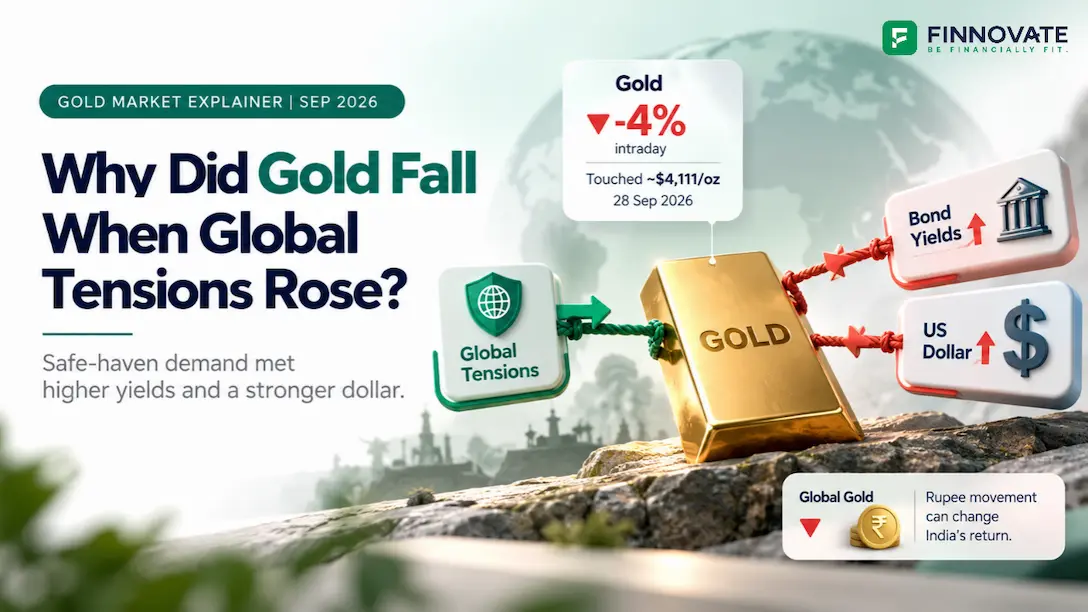
Why Did Gold Fall When Global Tensions Rose?
Why can gold prices fall during global tensions? Understand how bond yields, interest rate...
30 September 2026

Silver was one of the most stunning trades of 2025. Prices were up 150%+ in the year. Gold also rallied hard at 70%+, but silver still stole the spotlight.
So the natural question is not “wow”, it is “what changed?” Because rallies like this rarely run on just one reason.
Silver is not a “slow and steady” asset. It often behaves like a levered version of gold when markets get excited about precious metals. When the mood is bullish, silver can move faster. When the mood flips, it can also fall faster.
That volatility is the price you pay for the upside.
A popular explanation is the supply constraint story. Silver supply is limited because a lot of it is produced as a by-product of other metals, so supply cannot quickly respond to price spikes.
But here is the catch. Silver has been persistently undersupplied since 2021. The demand–supply gap has been in the 10% to 15% range for years. Yet the big price breakout only showed up in 2025.
Even the “ETF demand exploded” angle does not fully close the gap. Silver ETF demand in 2025 was around 70 million ounces, which is roughly similar to 2024.
So yes, supply tightness matters. But it does not explain the timing of the 2025 surge on its own.
If the present demand did not suddenly jump, the market likely started pricing the future differently.
Silver sits at the intersection of “old money” and “new economy”:
Now add this to the supply picture. The quantum of silver mined in 2025 is stated to be lower than in 2016, while industrial demand over the same period has grown by nearly 40%.
That combination creates a powerful narrative: “future demand is rising, supply is not.” Markets tend to price narratives early, sometimes far ahead of actual consumption.

Silver’s rally also makes more sense when you see it as part of a broader precious-metals move.
Historically, the pattern often looks like this:
This was visible in earlier cycles like 1979 and 2011. In 1979, gold rallied about 160% while silver surged around 415%.
The mechanism that often gets discussed here is the gold–silver ratio.
The gold–silver ratio tells you how many ounces of silver equal one ounce of gold. It typically sits in a broad range of 60–80.
At the peak of the gold rally in early 2025, the ratio reportedly crossed 100. Later, it fell to around 57. That fall usually implies silver “caught up” relative to gold, and that catch-up can drive sharp silver outperformance.
In other words, part of silver’s rally can be explained as a ratio reset, not just a standalone silver story.
Even when both rally together, silver is structurally different from gold.
A smaller pool means flows can move prices more aggressively in both directions. Silver can give you big spikes, but it also has a history of deep drawdowns and long stretches where prices go nowhere.
The honest answer: it depends on what you think you own.
If you own silver thinking it behaves like gold, you may be disappointed. Silver often behaves like a high-volatility add-on to the precious metals theme. It can rise sharply, but it can also erase gains quickly on the way down.
That is why a more practical way to think about silver is as part of a precious-metals basket, instead of treating it as a core long-term anchor by itself.
One framework mentioned in the source is a 15%–20% allocation to precious metals, with gold as the main component and silver as a smaller portion. The idea is simple: gold provides stability, silver adds potential upside, and the basket approach reduces the risk of getting whipsawed by silver’s volatility.
Disclaimer: This article is for informational and educational purposes only and does not constitute investment advice.
No spam. Only new posts, simple explainers, and practical money checklists for busy professionals.
Finnovate is a SEBI-registered financial planning firm that helps professionals bring structure and purpose to their money. Over 3,500+ families have trusted our disciplined process to plan their goals - safely, surely, and swiftly.
Our team constantly tracks market trends, policy changes, and investment opportunities like the ones featured in this Weekly Capsule - to help you make informed, confident financial decisions.
Learn more about our approach and how we work with you:
No comments yet. Start the conversation. What would you add?
No spam. Only new posts, simple explainers, and practical money checklists.
You may also like
Why can gold prices fall during global tensions? Understand how bond yields, interest rate...

Global gold has fallen ~27% from its January 2026 peak. India's gold loan market is estima...

NSE launched Electronic Gold Receipts on May 4, 2026. EGRs offer physical delivery and a 1...
January 2026 gold ETF inflows hit ₹24,040 crore, nearly matching active equity inflows. ...
Popular now

Learn how to easily download your NSDL CAS Statement in PDF format with our step-by-step g...

Looking for the best financial freedom books? Here’s a handpicked 2026 reading list with...
Learn what SIF investment means in India, SEBI rules, Rs 10 lakh minimum investment, avail...
Clear guide to mutual fund taxation in India for FY 2025–26 after July 2024 changes: equ...