

The Great Economic Decoupling of 2026: Oil, AI & India
Rising oil prices and booming AI investment are shaping an uneven global economy in 2026. ...
24 October 2026
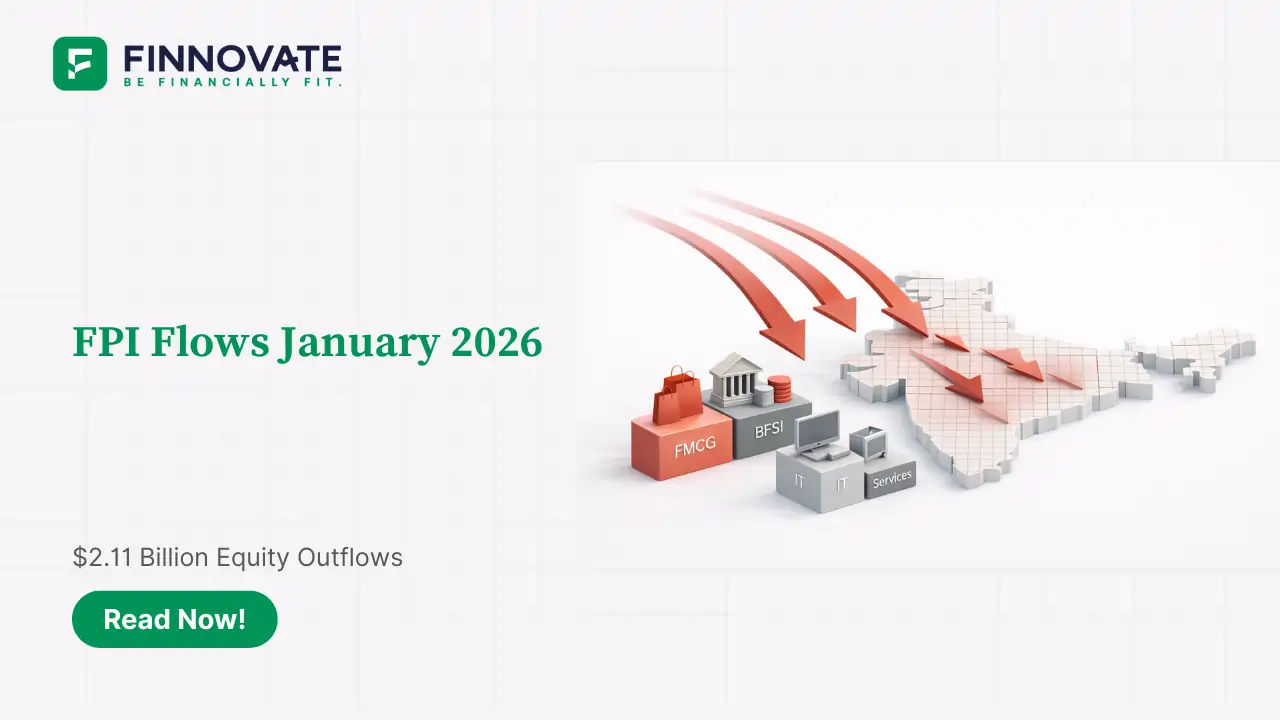
Foreign Portfolio Investors (FPIs) have begun 2026 on a cautious note. The first fortnight of January mirrors the trend seen in December 2025, with sustained selling pressure across Indian equities. Data from NSDL shows that FPIs were net sellers to the tune of $2.11 billion in equities during the first half of January 2026.
What is more concerning is not just the quantum of selling, but its breadth. Out of the 23 sectors tracked under the NSDL classification, 19 sectors witnessed net FPI outflows, indicating a broad-based risk-off approach rather than sector-specific profit booking.
The intensity of selling in early January has pushed FPI holdings in Indian equities to multi-year lows.
These numbers highlight a clear reduction in foreign exposure to Indian markets. FPIs appear to be cutting risk aggressively, driven by a combination of global uncertainty, currency pressures, and valuation concerns.
Historically, January is a crucial month for FPIs as it often reflects fresh allocation decisions for the year. The fact that selling has continued into January suggests that risk appetite toward Indian equities remains subdued.
Based on data published by NSDL, net FPI equity outflows during the first half of January 2026 amounted to $(2,108) million. The table below shows sector-wise FPI equity flows under the NSDL sectoral classification.
| Sector (NSDL Classification) | FPI Equity Flows ($ mn) | Sector (NSDL Classification) | FPI Equity Flows ($ mn) |
|---|---|---|---|
| Metals & Mining | +298 | Oil & Gas | -61 |
| Capital Goods | +36 | Realty | -78 |
| Consumer Durables | +36 | Healthcare | -116 |
| Chemicals | +8 | Others | -163 |
| Forest Materials | -1 | Telecommunication | -166 |
| Diversified | -2 | Services | -176 |
| Media & Entertainment | -14 | Consumer Services | -216 |
| Utilities | -14 | Information Technology (IT) | -230 |
| Textiles | -20 | Financial Services (BFSI) | -354 |
| Power | -38 | FMCG | -679 |
| Construction | -50 | Grand Total | -2,108 |
| Construction Materials | -53 | ||
| Automobile & Components | -55 |
Data Source: NSDL
The table clearly shows that FPI selling was not limited to a handful of sectors. Instead, exits were spread across consumption, financials, services, and defensives.
The only sector to witness meaningful FPI buying during the period was Metals & Mining, with inflows of $298 million.
This selective buying can be attributed to:
However, this buying appears tactical rather than a broad endorsement of risk assets.
The FMCG sector saw the highest selling pressure, with net FPI outflows of $679 million. Key factors include:
Despite its defensive nature, FMCG failed to attract FPI support in the current risk environment.
Two of the largest index sectors, Financial Services (BFSI) and Information Technology, saw combined outflows of $584 million.
Given their high index weights, selling in these sectors had a disproportionate impact on headline indices.
Beyond the major sectors, FPIs also reduced exposure to:
In several cases, this selling followed strong rallies over the previous year. FPIs appear to be booking profits in stocks that had seen sharp appreciation.
The current FPI sell-off is being driven by a mix of global and domestic factors.
Geopolitical risks escalated after:
Such developments typically result in capital moving away from emerging markets.
The Indian Rupee weakening to around ₹91 per US dollar has added to investor anxiety. Additionally, India’s non-inclusion in Bloomberg’s global bond indices has delayed potential debt inflows of nearly $25 billion.
India’s Buffett Ratio stands at approximately 125%, well above its long-term average of 90%, raising concerns about return potential amid slowing nominal growth.
India’s continued purchase of Russian oil, threats of penal tariffs by the US, and delays in finalising an Indo–US trade deal have further dampened sentiment.
January flows are often a proxy for fresh annual allocations. The sustained selling in early January 2026 suggests that FPIs remain cautious rather than positioning for a near-term rebound.
FPIs appear to be waiting for:
Until visibility improves, FPI participation in Indian equities is likely to remain selective.
Disclaimer: This article is for general information and educational purposes only. It does not constitute investment advice, a recommendation, or an offer to buy or sell any securities. Market and currency data are subject to change. Please consult a SEBI-registered investment adviser before taking any investment decision.
No spam. Only new posts, simple explainers, and practical money checklists for busy professionals.
Finnovate is a SEBI-registered financial planning firm that helps professionals bring structure and purpose to their money. Over 3,500+ families have trusted our disciplined process to plan their goals - safely, surely, and swiftly.
Our team constantly tracks market trends, policy changes, and investment opportunities like the ones featured in this Weekly Capsule - to help you make informed, confident financial decisions.
Learn more about our approach and how we work with you:
No comments yet. Start the conversation. What would you add?
No spam. Only new posts, simple explainers, and practical money checklists.
You may also like
Rising oil prices and booming AI investment are shaping an uneven global economy in 2026. ...

Explore FPI equity flows for October First Half, 2026: ₹47,955 crore in net outflows, th...

Understand the India–Mauritius tax treaty’s Principal Purpose Test, its August 2026 ef...

Explore India’s AI hardware opportunity through the proposed Adani–Jabil venture, from...
Popular now

Learn how to easily download your NSDL CAS Statement in PDF format with our step-by-step g...

Looking for the best financial freedom books? Here’s a handpicked 2026 reading list with...

Learn what SIF investment means in India, SEBI rules, Rs 10 lakh minimum investment, avail...

Clear guide to mutual fund taxation in India for FY 2025–26 after July 2024 changes: equ...