

The Great Economic Decoupling of 2026: Oil, AI & India
Rising oil prices and booming AI investment are shaping an uneven global economy in 2026. ...
24 October 2026
Summary: The Economic Survey 2025-26 presents an Indian economy that has successfully transitioned from post-pandemic recovery to a state of sustained high-frontier growth. With a Real GDP growth projection of 7.4% for FY26 and a revised potential growth rate of 7.0%, India is reinforcing its position as the fastest-growing major economy. The narrative shifts from traditional "Import Substitution" to a sophisticated pursuit of "Strategic Indispensability," where India aims to become a critical, non-substitutable node in global value chains.
In a global environment characterized by "managed disorder" and trade volatility, the Indian economy remains a beacon of stability. The First Advance Estimates (FAE) for FY26 project a Real GDP growth of 7.4% and GVA growth of 7.3%, outperforming previous conservative estimates.
Growth continues to be anchored by robust domestic demand. Private Final Consumption Expenditure (PFCE) as a share of GDP reached 61.5% in FY26, the highest level since FY12. This buoyancy is attributed to:
Gross Fixed Capital Formation (GFCF) remained steady at 30.0% of GDP. The survey highlights a "virtuous cycle" of investment, where sustained public capital expenditure (reaching 4.0% of GDP) is effectively crowding in private investment.
| Production Approach (Supply Side) | H1: FY25 | H1: FY26 | FY25 (PE) | FY26 (FAE) |
|---|---|---|---|---|
| Agriculture, Livestock, Forestry & Fishing | 2.7 | 3.6 | 4.6 | 3.1 |
| Industry | 6.1 | 7 | 5.9 | 6.2 |
| Mining & Quarrying | 3.6 | -1.8 | 2.7 | -0.7 |
| Manufacturing | 4.8 | 8.4 | 4.5 | 7.0 |
| Electricity, Gas, Water Supply & Other Utility Services | 6.5 | 2.4 | 5.9 | 2.1 |
| Construction | 9.3 | 7.4 | 9.4 | 7.0 |
| Services | 7.0 | 9.3 | 7.2 | 9.1 |
| Trade, Hotels, Transport, Communication & Services related to Broadcasting | 5.8 | 8 | 6.1 | 7.5 |
| Financial, Real Estate & Professional Services | 6.9 | 9.9 | 7.2 | 9.9 |
| Public Administration, Defence & Other Services | 8.9 | 9.7 | 8.9 | 9.9 |
| GVA at Basic Prices | 6.2 | 7.9 | 6.4 | 7.3 |
|
Expenditure Components (Demand Side)
|
||||
| Private Final Consumption Expenditure (PFCE) | 7.3 | 7.5 | 7.2 | 7.0 |
| Government Final Consumption Expenditure (GFCE) | 1.9 | 2.5 | 2.3 | 5.2 |
| Gross Fixed Capital Formation (GFCF) | 6.7 | 7.6 | 7.1 | 7.8 |
| Exports | 5.5 | 5.9 | 6.3 | 6.4 |
| GDP | 6.1 | 8.0 | 6.5 | 7.4 |
India’s fiscal trajectory is marked by a "credible consolidation" that has won the confidence of global markets, resulting in a landmark credit rating upgrade by S&P from BBB- to BBB in 2025.
The Union Government has fulfilled its 2021 promise to reduce the fiscal deficit by more than half from the pandemic peak.
Monetary policy has pivoted to an accommodative stance as inflation eased, with a cumulative reduction of 125 basis points in the repo rate since February 2025. The banking sector is at its healthiest in decades, with Gross Non-Performing Assets (GNPA) at multi-decade lows of 2.2%.
Headline CPI inflation witnessed a sharp decline to 1.7% in the April-December 2025 period, driven primarily by a massive disinflation in food prices, specifically vegetables and pulses.
While core inflation appears "sticky," the Survey clarifies that this is largely due to price spikes in precious metals (Gold and Silver). Adjusting for these, underlying inflationary pressures remain materially soft.
-Inflation.png)
On the supply side, the growth story is increasingly service-led, though manufacturing remains a strategic priority.
Perhaps the most significant intellectual contribution of this Survey is the introduction of a new tiered framework for India's economic sovereignty.
The Survey calls for the state machinery to evolve into an "Entrepreneurial State" - one that acts under uncertainty, structures risk rather than avoids it, and corrects course without paralysis.
| Dimension | Import Substitution | Strategic Resilience | Strategic Indispensability |
|---|---|---|---|
| Economic Focus | Mainly sectoral (manufacturing, consumer goods, intermediate goods). | Systemic (spans energy, food, data, health, defence, infrastructure, and technology). | Global-embedding national industries and technologies as indispensable nodes in global networks. |
| Time Horizon | Short-to-medium term industrial policy tool. | Medium-to-long term national capability framework. | Long-term structural positioning in global value chains and institutions. |
| Geographic Logic | Produce at home: focus on domestic value addition. | Diversify and secure: mix of domestic, allied, and friendly sources. | Shape and anchor: build and control critical global interdependencies. |
The Chief Economic Advisor, V. Anantha Nageswaran, outlines three possible trajectories for the coming year, highlighting that global uncertainty is now structural:
India’s external sector remains manageable but faces headwinds from a global system that no longer rewards macroeconomic success with automatic stability.
The Economic Survey 2025-26 concludes that India is no longer just a "follower" of global trends but is actively shaping its destiny through an "Entrepreneurial State" and "Strategic Sobriety". By revising potential growth upward to 7.0%, the Survey signals that the cumulative impact of structural reforms from GST 2.0 to Labour Codes - is now paying dividends.
As India navigates the "Pax Silica" era of AI and critical minerals, the focus remains on building a resilient, innovative, and indispensable nation.
Real GDP is projected at 7.4%.
The target is 4.4% of GDP.
It is the goal of making India a critical, non-substitutable node in global value chains.
Disclaimer: This article is for general information and educational purposes only and is based on the Economic Survey 2025-26. It should not be treated as financial, investment, legal, or tax advice. Please consult a qualified professional before making any decisions based on this content.
No spam. Only new posts, simple explainers, and practical money checklists for busy professionals.
Finnovate is a SEBI-registered financial planning firm that helps professionals bring structure and purpose to their money. Over 3,500+ families have trusted our disciplined process to plan their goals - safely, surely, and swiftly.
Our team constantly tracks market trends, policy changes, and investment opportunities like the ones featured in this Weekly Capsule - to help you make informed, confident financial decisions.
Learn more about our approach and how we work with you:
No comments yet. Start the conversation. What would you add?
No spam. Only new posts, simple explainers, and practical money checklists.
You may also like
Rising oil prices and booming AI investment are shaping an uneven global economy in 2026. ...
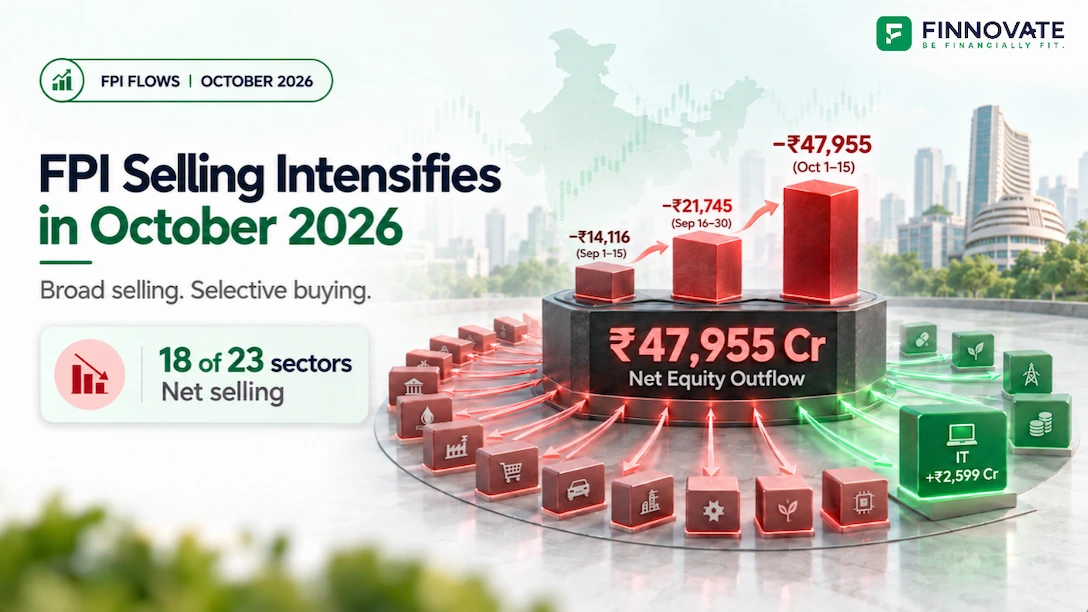
Explore FPI equity flows for October First Half, 2026: ₹47,955 crore in net outflows, th...
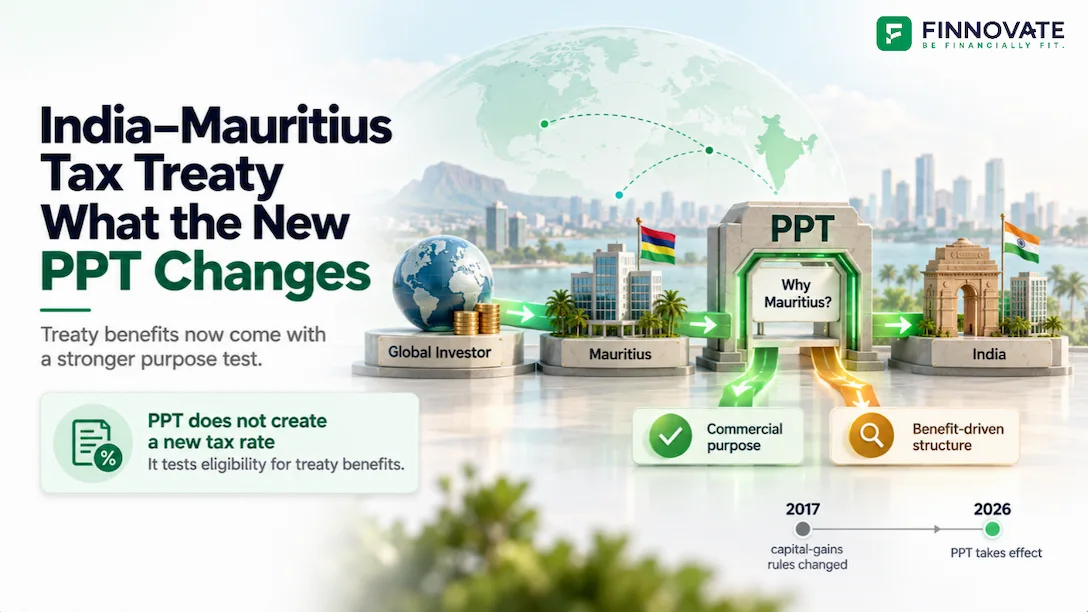
Understand the India–Mauritius tax treaty’s Principal Purpose Test, its August 2026 ef...

Explore India’s AI hardware opportunity through the proposed Adani–Jabil venture, from...
Popular now

Learn how to easily download your NSDL CAS Statement in PDF format with our step-by-step g...

Looking for the best financial freedom books? Here’s a handpicked 2026 reading list with...
Learn what SIF investment means in India, SEBI rules, Rs 10 lakh minimum investment, avail...
Clear guide to mutual fund taxation in India for FY 2025–26 after July 2024 changes: equ...