

SEBI’s New AIF Reporting Framework 2026: Investor Guide
SEBI’s March 2026 AIF reporting overhaul introduces an Annual Activity Report and a limi...
05 March 2026
Published: May 2026 | For HNIs, NRIs and Professionals
Category III AIFs have recorded the fastest growth among all three AIF categories. According to SEBI AIF Statistics (December 2025), Category III commitments reached Rs 3.11 lakh crore, up 43.3% year-on-year, compared to 16.1% for Category II and 15.5% for Category I in the same period. It is one of the largest AIF categories by fund and investor count, with the majority of HNI-facing AIF products operating in listed equity markets. It is also one of the most discussed and misunderstood categories in the AIF space.
The question most investors arrive with is not "what is Category III." It is: "My wealth manager has pitched me a Category III AIF. I already have a PMS. Is this actually different, or is it the same strategy in a more expensive wrapper?" This article answers that question with numbers, not generalities.
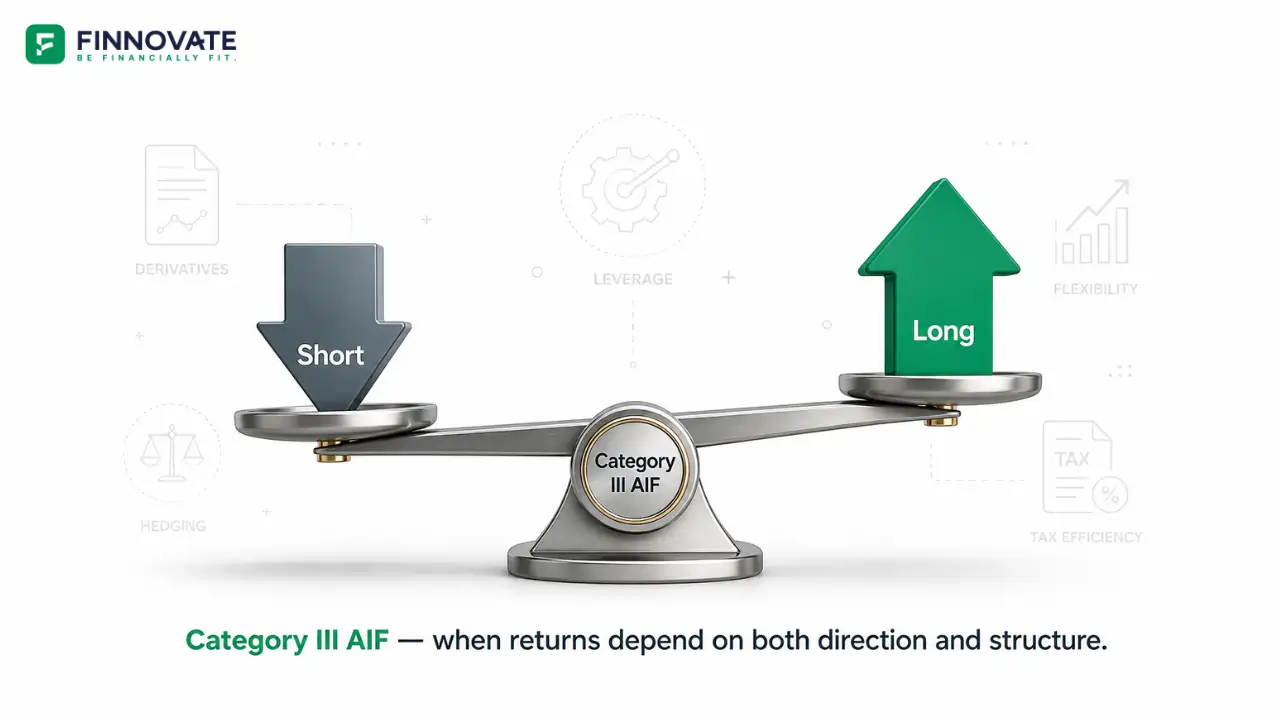
Under SEBI (Alternative Investment Funds) Regulations, 2012, Category III AIFs are funds that employ diverse or complex trading strategies and may use leverage through investment in listed or unlisted derivatives. They are the only AIF category explicitly permitted to use leverage for investment purposes.
In practice, a Category III AIF is a SEBI-registered pooled investment vehicle, structured as a trust in most Indian cases, that invests in listed and unlisted securities using strategies that go beyond long-only equity. The strategy may involve taking short positions, using derivatives for hedging or alpha generation, arbitrage across instruments, or private investment in listed companies.
Category III is the only AIF category designed for complex strategies including leverage (up to 2x NAV) and permitted derivative-based short exposure. These two capabilities define everything else about the category.
Category III does not have SEBI pass-through tax status under Section 115UB, which applies to Category I and II. Tax is settled at the fund level in most structures before investors receive distributions.
| Parameter | Category III |
|---|---|
| Structure | Open-ended or close-ended (fund's choice; unique to Category III) |
| Leverage | Permitted up to 2x NAV per SEBI circular CIR/IMD/DF/10/2013 |
| Minimum investment | Rs 1 crore (Rs 25 lakh for employees or directors of AIF or Manager) |
| Minimum corpus per scheme | Rs 20 crore |
| Sponsor commitment | 5% of corpus or Rs 10 crore, whichever is lower (higher than Category I and II) |
| Tax treatment | Fund-level in most structures; no Section 115UB pass-through |
| Short exposure | Permitted through approved instruments and derivatives within the fund mandate and SEBI limits |
| Derivatives | Permitted for hedging and alpha generation |
| TDS on distributions | Category III income is taxed at fund level before distribution. Section 194LBB (which applies to Category I and II pass-through distributions) does not apply in the same manner. TDS treatment should be verified from the fund's tax note and distribution statement. |
Category III covers a wide range of strategies. The differences between them are material, not cosmetic. An investor in a long-only equity AIF and an investor in a long-short fund are in fundamentally different products, despite both being Category III.
Invest in listed equities using bottom-up stock selection. No short positions are taken. Derivatives may be used for hedging. The strategy is substantially similar to a PMS: concentrated, manager-driven, listed equity. The key structural difference from PMS is the pooled trust format rather than direct demat ownership. Well-known Category III long-only managers include Motilal Oswal, ASK, Alchemy, IIFL, Abakkus, and Sage One.
Take simultaneous long and short positions in listed equities through permitted derivative instruments. The fund manager buys stocks expected to appreciate and sells stocks expected to decline. Net market exposure (long minus short) determines whether the fund is directional or market-neutral. A fund with 80% long and 20% short has 60% net long exposure. A fund with 50% long and 50% short is market-neutral. Leverage is commonly used within the 2x NAV ceiling. Well-known Category III long-short managers include Tata, Kotak, Avendus, IIFL, Edelweiss, and ITI.
Category III funds are not unrestricted hedge funds. They operate within SEBI's concentration limits, derivative exposure limits, and the 2x NAV leverage ceiling. The flexibility is meaningful but bounded by regulatory design.
Exploit pricing inefficiencies between related instruments: cash-futures spreads, merger arbitrage, index rebalancing effects. Returns are lower and more consistent than directional strategies, with limited market correlation. The fund can generate positive returns regardless of broader market direction if the pricing inefficiency is captured correctly.
Invest in listed companies through privately negotiated placements at discounted prices, typically with a lock-in of six to twelve months. PIPE combines elements of private market access with listed company exposure. Returns depend on the discount at entry and the stock's performance after the lock-in expires. Risk includes being locked in during adverse market conditions.
For most HNI investors being pitched a Category III AIF, the most important distinction is between long-only and long-short. This choice drives the tax analysis, the fee justification, and the comparison with PMS.
Returns come entirely from picking stocks that appreciate. The fund rises and falls with the market. Downside depends on position sizing. Strategy is replicable in a PMS structure with better post-tax outcomes for most investors.
Returns come from both appreciation of longs and depreciation of shorts. The fund can generate positive returns in falling markets if relative positioning is correct. Short-side skill is a distinct and harder-to-evaluate capability than long-side stock picking.
Category III taxation is the single most important factor in the PMS vs Category III comparison for high-income investors. It is also the area with the most recent legal development.
Category III AIFs do not have pass-through tax status under Section 115UB. In most trust structures, the fund pays tax on income before distributing returns to investors. Investors receive post-tax distributions and are not taxed again on the same income in India.
In Equity Intelligence AIF Trust v. CBDT (2025: DHC: 6170-DB, July 29, 2025), the Delhi High Court held that a Category III AIF trust is not automatically indeterminate merely because investor names are absent from the original trust deed. If beneficiary interests are ascertainable through contribution agreements, KYC records, and SEBI-mandated registers, the trust is determinate.
The court read down CBDT Circular No. 13/2014, which had previously mandated investor names in the original trust deed as a prerequisite for determinate treatment. Where a Category III AIF trust is treated as determinate and income is eligible capital gains, the fund may be able to apply relevant capital gains rates instead of MMR. This depends on the fund documents, beneficiary identification, income characterisation, and current legal position. The ruling is from the Delhi High Court (not Supreme Court) and the tax department's appeal status should be confirmed with legal counsel before drawing conclusions about a specific fund's tax treatment.
What the ruling means in practice: Income characterised as business income, including many derivative and active trading gains, may still be taxed at MMR depending on the trust structure and tax computation. Where the trust is determinate and income is eligible capital gains, concessional rates may apply. The actual outcome depends on the fund's income characterisation, trust structure, and current legal position. Verify the tax note in the PPM and seek external legal opinion before drawing post-tax conclusions.
| Factor | Determinate trust | Indeterminate trust |
|---|---|---|
| Tax applicable | Concessional rates on eligible capital gains; MMR on business income | MMR on entire income (~42.744% old regime) |
| How to verify | Check PPM tax note; request post-DHC ruling legal opinion from fund manager | Check whether fund has updated structure post July 2025 ruling |
This is the calculation most investors do not run before investing. The numbers below are illustrative using verified FY 2025-26 tax parameters. They are not projections or return guarantees.
| Feature | Category III AIF | PMS |
|---|---|---|
| Minimum investment | Rs 1 crore | Rs 50 lakh |
| Ownership | Pooled trust; investor holds fund units | Direct; securities in investor's own demat |
| Strategy range | Long-only, long-short, arbitrage, derivatives, PIPE | Primarily long-only listed equity |
| Leverage | Up to 2x NAV (permitted) | Not applicable |
| Short exposure | Permitted via derivatives within stated strategy mandate | Not permitted |
| Liquidity | Open-ended: periodic redemption windows; close-ended: fund terms | Generally aligned with exchange trading hours |
| Transparency | Periodic NAV and fund reports | Real-time portfolio visibility in demat |
| Tax on equity gains | Fund-level (MMR for business income; concessional for capital gains in determinate trust) | Investor-level LTCG 12.5% or STCG 20% |
| Management fee deductibility | Not available to investors | A debated and litigated tax position; confirm with CA before assuming this benefit |
| Better suited when | Long-short, absolute return, market-neutral, derivative-linked strategies | Long-only listed equity with direct ownership preference |
The key conclusion: PMS is often more tax-efficient for pure long-only listed equity strategies, especially where the Category III AIF is taxed at fund-level MMR. Category III adds genuine value when the strategy involves derivative-based short exposure, leverage, or market-neutral positioning: capabilities that PMS structurally cannot replicate. For a long-only Category III AIF running an identical strategy to an existing PMS and taxed at MMR, the post-tax case for the AIF is weak in most scenarios.
The 2x NAV leverage limit means the fund can take gross investment exposure of up to twice its net asset value. If the fund has Rs 100 crore in NAV, it can hold positions worth up to Rs 200 crore in aggregate.
A Rs 100 crore fund operating at 2x leverage might hold Rs 120 crore in long positions and Rs 80 crore in short positions. Gross exposure is Rs 200 crore (the SEBI limit). Net exposure is Rs 40 crore long.
The AIF Beginner's Guide covers the general PPM checklist. Category III warrants additional scrutiny on specific points that are unique to leveraged and complex strategies.
Category III is not a universal upgrade from PMS or mutual funds. It suits a specific investor profile, and that profile has a financial floor below which the product is unlikely to be the right first alternative investment.
| Investor situation | Category III fit | Key consideration |
|---|---|---|
| Strong core portfolio in place (equity, MF, PMS, fixed income) | Good fit as satellite allocation | Category III works as an addition, not a foundation |
| Wants long-short, market-neutral, or absolute return exposure | Strong fit | These strategies are not available in PMS |
| Highest income bracket; tax-sensitive | Conditional fit | Category III fund must deliver 3-4% gross premium over PMS just to break even post-tax at MMR |
| Wants long-only equity strategy | Weak fit | PMS is typically more tax-efficient for the same strategy |
| Making first AIF allocation | Not recommended as first step | Category II (private equity or private credit) offers clearer mandate, no leverage, pass-through taxation |
| May need capital within 1-2 years | Weak fit | Open-ended funds have redemption windows; close-ended funds lock capital for full tenure |
These go beyond the generic checklist. They separate managers with a clear, repeatable process from those with a compelling performance narrative.
We review your income, goals, existing investments, tax bracket, and liquidity position before discussing any instrument.
Book a ConsultationCategory III AIFs are SEBI-registered funds that employ complex or diverse trading strategies, including leverage and derivatives, in listed and unlisted securities. They are the only AIF category permitted to use leverage for investment purposes (up to 2x NAV) and to deploy permitted derivative-based short exposure. Common strategies include long-only equity, long-short equity, arbitrage, and PIPE (Private Investment in Public Equity).
Category III AIFs do not have pass-through tax status under Section 115UB. In most trust structures, the fund pays tax on income before distributing returns to investors. For indeterminate trusts, the Maximum Marginal Rate (approximately 42.744% under the old regime) applies on the entire income. Following the July 2025 Delhi High Court ruling in Equity Intelligence AIF Trust v. CBDT, where a trust is treated as determinate and income is eligible capital gains, concessional rates may apply instead of MMR. This depends on fund documents, income characterisation, and current legal position. The ruling is from the Delhi HC, not the Supreme Court. Investors should verify the trust structure and income characterisation in the PPM's tax note and seek external legal opinion.
PMS holds securities directly in the investor's demat account, has a minimum of Rs 50 lakh, taxes gains at the investor level (LTCG 12.5% or STCG 20% for listed equity), and is limited to long-only strategies. Category III AIF pools capital in a trust structure, has a minimum of Rs 1 crore, is taxed at the fund level in most structures, and can use leverage and deploy permitted derivative-based short exposure. PMS is often more tax-efficient for pure long-only listed equity strategies, especially where the Category III AIF is taxed at fund-level MMR. Category III adds value when the strategy genuinely requires derivative-linked strategies, leverage, or market-neutral positioning.
Yes. Category III AIFs are the only AIF category permitted to use leverage for investment purposes, up to 2x NAV per SEBI circular CIR/IMD/DF/10/2013. Derivative-based short exposure is also permitted. Category I and II AIFs cannot use leverage for investment, only for day-to-day operational needs. Leverage amplifies both gains and losses; investors should verify the fund's leverage policy and deleveraging thresholds in the PPM.
A long-only Category III AIF invests only in stocks expected to appreciate, with no short positions. The strategy is substantially similar to a PMS. A long-short Category III AIF takes simultaneous long and short positions through permitted derivative instruments, seeking to profit from the appreciation of long holdings and the depreciation of short positions. Long-short funds can generate positive returns in falling markets if relative positioning is correct. Short-side skill is harder to evaluate than long-side stock picking and requires separate attribution analysis.
For pure long-only listed equity exposure, PMS is often more tax-efficient, especially where the Category III AIF is taxed at fund-level MMR. For long-short strategies, market-neutral strategies, or derivative-linked approaches, Category III offers capabilities that PMS cannot replicate. The decision depends on the specific strategy, the fund's trust structure and tax note, and the investor's income bracket and existing portfolio. Please consult a SEBI-registered investment adviser before making any allocation decision.
The minimum investment for a standard investor in a Category III AIF is Rs 1 crore per scheme. Employees or directors of the AIF or its Manager can invest with a minimum of Rs 25 lakh. Accredited investors meeting SEBI's income or net worth criteria may have flexibility depending on fund terms. Each scheme requires a minimum corpus of Rs 20 crore.
The Maximum Marginal Rate (MMR) applicable to indeterminate trust structures is approximately 42.744% under the old tax regime: 30% base rate plus 37% surcharge plus 4% health and education cess. This applies to the entire income of an indeterminate trust. For determinate trusts post the July 2025 Delhi HC ruling, concessional rates may apply on eligible capital gains income. Business income, including many derivative and active trading gains, may still be taxed at MMR depending on the trust structure and tax computation.
Category III may not be the right first AIF allocation for many investors. The complexity of leverage, complex strategies, fund-level taxation, and liquidity risk typically warrants a Category II allocation (private equity or private credit) as a first AIF investment. Category III is better suited as a satellite allocation within a portfolio that already has a strong core of listed equity, mutual funds, PMS, and fixed income.
No. Investors in Category III AIFs receive post-tax distributions and are not taxed again on the same income in India. The fund pays tax at the applicable rate before distributing. Section 194LBB, which governs TDS on pass-through distributions for Category I and II AIFs, does not apply to Category III distributions in the same manner since income is already taxed at the fund level. TDS treatment and reporting should be verified from the fund's tax note and distribution statement. NRI investors should verify DTAA applicability with their CA before distribution.
Disclaimer: This article is for educational purposes only. It does not constitute investment advice, tax advice, legal advice, a recommendation, or an offer to buy or sell any securities or financial instruments. Tax calculations are illustrative using FY 2025-26 parameters and are not projections or guarantees of return. The Delhi High Court ruling referenced (Equity Intelligence AIF Trust v. CBDT, 2025: DHC: 6170-DB) is stated for informational purposes; tax treatment depends on specific fund structure and professional legal opinion. AIF investments are subject to market risks, illiquidity, and significant lock-in periods. Please consult a qualified Chartered Accountant and a SEBI-registered investment adviser before making any investment decision.
No spam. Only new posts, simple explainers, and practical money checklists for busy professionals.
Finnovate is a SEBI-registered financial planning firm that helps professionals bring structure and purpose to their money. Over 3,500+ families have trusted our disciplined process to plan their goals - safely, surely, and swiftly.
Our team constantly tracks market trends, policy changes, and investment opportunities like the ones featured in this Weekly Capsule - to help you make informed, confident financial decisions.
Learn more about our approach and how we work with you:
No comments yet. Start the conversation. What would you add?
No spam. Only new posts, simple explainers, and practical money checklists.
You may also like
SEBI’s March 2026 AIF reporting overhaul introduces an Annual Activity Report and a limi...
Learn how Alternative Investment Funds (AIFs) are taxed in India. A complete guide to Pass...
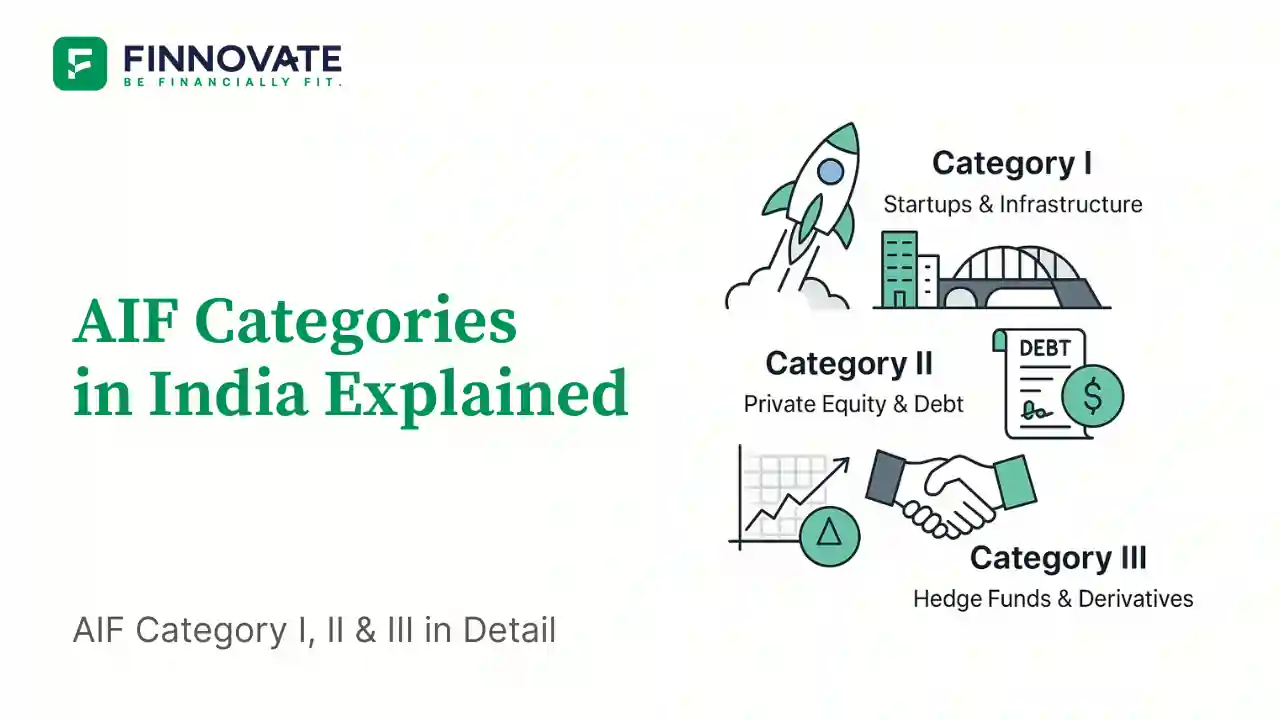
Learn about the three SEBI-approved AIF categories in India – Category I, II & III. Unde...

Learn what Alternative Investment Funds (AIFs) are, how they work in India, AIF categories...
Popular now
Learn how to easily download your NSDL CAS Statement in PDF format with our step-by-step g...

Looking for the best financial freedom books? Here’s a handpicked 2026 reading list with...
Learn what SIF investment means in India, SEBI rules, Rs 10 lakh minimum investment, avail...

Clear guide to mutual fund taxation in India for FY 2025–26 after July 2024 changes: equ...