

Tax Planning and Benefits for Married Couples in India: 2026 Guide
Tax planning for married couples in India explained for 2026. Compare tax regimes, deducti...
05 September 2026
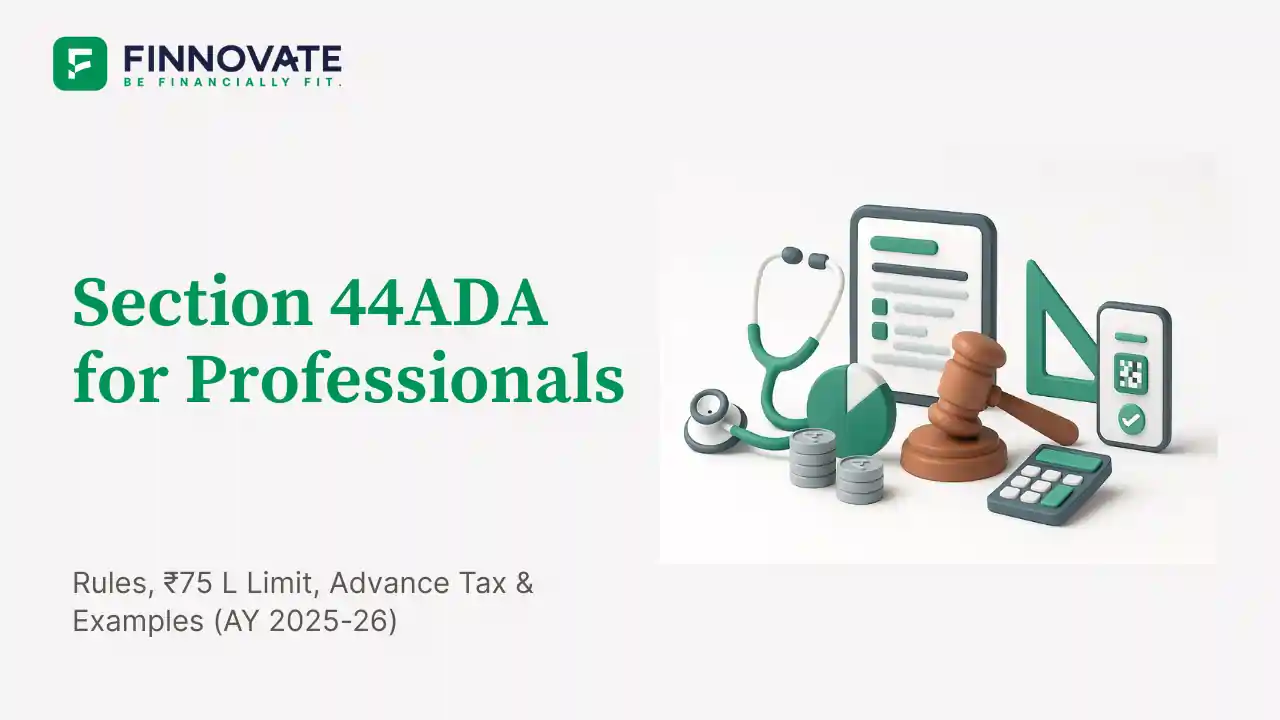
If you are a practising professional in India, Section 44ADA lets you pay tax on a presumptive basis: declare 50% of your gross receipts as income and skip detailed books and audit, subject to eligibility conditions. This guide covers who qualifies, the limits that apply, how the income calculation works, and what compliance involves, with worked scenarios throughout.
Quick Answer: What is Section 44ADA?
Section 44ADA is a presumptive taxation scheme for specified professionals. Instead of maintaining full books and getting audited, eligible professionals declare 50% of gross receipts as taxable profit and file a simplified return.
| Condition | Detail |
|---|---|
| Who qualifies | Resident individuals and resident partnership firms (not LLPs). HUFs are not eligible under Section 44ADA. |
| Gross receipts limit | Up to Rs 50 lakh (any payment mix); up to Rs 75 lakh if cash receipts are 5% or less of total gross receipts |
| Deemed profit rate | 50% of gross receipts. Fixed. No separate expense deductions beyond this. |
| Chapter VI-A deductions | Still available under old regime (Section 80C, 80D etc.) against deemed profit. Not available under new regime. |
| Lock-in period | None. Opt in or out every year. (Section 44AD for businesses has a 5-year lock-in; 44ADA does not.) |
Example: A resident architect earns gross receipts of Rs 40 lakh in FY 2025-26. Deemed profit under 44ADA: Rs 20 lakh (50%). Actual expenses of Rs 10 lakh are irrelevant: no separate deduction is allowed. The Rs 20 lakh is taxable income from profession. Section 80C deductions (if on old regime) can then be applied against this Rs 20 lakh.
Specified professions include legal, medical, engineering, architecture, accountancy, technical consultancy, interior decoration, and others notified by CBDT. Please consult a qualified Chartered Accountant for guidance specific to your situation.
Table of Contents
Section 44ADA is a presumptive taxation scheme for certain professions. Instead of maintaining full books of accounts and getting them audited, eligible professionals can declare 50% of their gross professional receipts as taxable profit and file a simplified return.
Legal, Medical, Engineering or Architecture, Accountancy, Technical Consultancy, Interior Decoration, and other professions notified by the CBDT (which include film artists, authorised representatives, and others).
Professionals and business owners are often confused about which presumptive section applies. The two schemes are distinct. Salaried individuals fall under neither.
| Feature | Section 44ADA (Professionals) | Section 44AD (Businesses) | Salaried Individuals |
|---|---|---|---|
| Who it covers | Resident individuals and partnership firms (not LLPs) in specified professions | Resident individuals, HUFs, and partnership firms (not LLPs) in eligible businesses | Not covered by either section |
| Deemed income rate | 50% of gross receipts | 6% (digital receipts) or 8% (cash receipts) of turnover | Salary taxed under Salaries head; no presumptive scheme |
| Gross receipts / turnover limit | Rs 50L (or Rs 75L if cash under 5%) | Rs 2 crore (or Rs 3 crore if cash under 5%) | Not applicable |
| Lock-in period | None | 5 years under Section 44AD(4) | Not applicable |
| ITR form | ITR-4 (Sugam) if eligible; otherwise ITR-3 | ITR-4 (Sugam) if eligible; otherwise ITR-3 | ITR-1 or ITR-2 |
The Income Tax Department's own ITR-4 FAQ page confirms the applicable limits for Section 44ADA in FY 2025-26 (AY 2026-27).
| Condition | Applicable Limit |
|---|---|
| Standard limit (any payment mix) | Gross receipts up to Rs 50 lakh |
| Enhanced limit (digital-heavy receipts) | Up to Rs 75 lakh, provided cash receipts do not exceed 5% of total gross receipts (i.e., at least 95% received via banking channels, UPI, cheque, electronic clearing, or other recognised modes) |
If a partnership firm opts for Section 44ADA, partner salary or interest is not separately deducted from the 50% deemed income under presumptive computation. The 50% deemed profit is treated as the final income from the profession; further expense deductions are not separately carved out. This differs from normal books of accounts where such deductions are permitted under Section 40(b). This is a frequently missed point for professional partnership firms.
If you declare 50% or more of gross receipts as profit under Section 44ADA, books of account and tax audit are not required. If you declare lower than 50%, the normal books and audit provisions may apply, especially where total income exceeds the basic exemption limit. Whether a tax audit under Section 44AB is required in a specific situation should be verified with a qualified Chartered Accountant.
Under Section 44ADA, 100% of advance tax must be paid by 15 March of the financial year. Any amount paid on or before 31 March is also treated as advance tax for that year. However, interest under Section 234C may apply for the period between 15 March and the actual payment date. Delays beyond 31 March attract interest under both Sections 234B and 234C.
File ITR-4 (Sugam) if eligible: resident individual or partnership firm other than LLP, total income not exceeding Rs 50 lakh, income computed on presumptive basis, and long-term capital gains under Section 112A not exceeding Rs 1.25 lakh. Otherwise file ITR-3.
| Case | Gross Receipts | Cash Share | Eligible? | Reason |
|---|---|---|---|---|
| 1 | Rs 47 lakh | 15% | Yes (Rs 50L cap) | Within Rs 50 lakh standard limit. Cash share above 5% but irrelevant since below Rs 50L. |
| 2 | Rs 70 lakh | 3% | Yes (Rs 75L cap) | At least 95% via banking/UPI. Enhanced limit of Rs 75 lakh applies. |
| 3 | Rs 60 lakh | 8% | No | Exceeds Rs 50 lakh standard limit. Cash share above 5% means Rs 75 lakh cap is unavailable. |
The numbers below illustrate how the presumptive route compares with normal books for professionals in different expense situations. The appropriate choice depends on the individual's actual numbers, tax position, and compliance preferences.
| Case | Receipts | Expenses | 44ADA Profit (50%) | Normal Books Profit | Comparative Outcome |
|---|---|---|---|---|---|
| 1 | Rs 45 lakh | Rs 16 lakh | Rs 22.5 lakh | Rs 29 lakh | 44ADA produces lower taxable profit here; also avoids audit |
| 2 | Rs 60 lakh (at least 95% digital) | Rs 30 lakh | Rs 30 lakh | Rs 30 lakh | Profit identical; 44ADA avoids audit without changing tax liability |
| 3 | Rs 70 lakh (at least 95% digital) | Rs 35 lakh (incl. partner remuneration) | Rs 35 lakh | Rs 35 lakh | Identical profit; note partner remuneration not separately deductible under 44ADA |
Note: Under 44ADA, no separate deduction is allowed for partner salary or interest. The 50% deemed profit subsumes all expenses. Under normal books, the profit and loss account determines the taxable figure.
Whether to opt for the presumptive scheme depends on your actual expense ratio, income level, and filing situation. Our advisory team can help you compare the outcomes for your specific numbers.
Book a Tax Planning CallYes. Section 44ADA has no five-year lock-in period, unlike Section 44AD(4) which applies to businesses. Professionals can opt in or out of the presumptive scheme every year based on their receipts and expense position.
No, if you declare 50% or more of gross receipts as profit and your receipts are within the applicable limit. If you declare lower than 50%, the normal books and audit provisions may apply, especially where total income exceeds the basic exemption limit. Whether a tax audit under Section 44AB applies in a specific situation should be verified with a qualified Chartered Accountant.
Depreciation is deemed to have been allowed under 44ADA, and the written-down value of assets is adjusted accordingly for future years. Chapter VI-A deductions such as Section 80C and Section 80D can still be claimed against the presumptive income under the old tax regime.
Under presumptive computation under Section 44ADA, partner salary or interest is not separately deducted from the 50% deemed income. The 50% is treated as the final professional income; further expense deductions are not separately carved out the way they would be under normal books. This differs from normal book-keeping where Section 40(b) permits such deductions from computed profit.
Cash receipts above 5% of total gross receipts means the digital-receipts condition is not met. The Rs 75 lakh enhanced cap is unavailable. Since gross receipts of Rs 60 lakh also exceed the standard Rs 50 lakh limit, Section 44ADA will not be available. Whether a tax audit under Section 44AB applies should be checked under the normal audit provisions based on actual facts. Please consult a qualified Chartered Accountant for your specific situation.
Yes. Section 44ADA is a method of computing professional income, not a regime selection. It works under both old and new tax regimes. Under 44ADA, professional income is computed at 50% of gross receipts regardless of which regime is chosen. The difference is that Chapter VI-A deductions (Section 80C, 80D, etc.) can only be applied against the deemed profit under the old tax regime. Under the new regime, those deductions are not available, but the new regime's slab rates and rebate structure apply to the 44ADA income in the usual way.
Disclaimer: This article is for general information and educational purposes only. It does not constitute tax advice, investment advice, or a recommendation regarding any tax filing decision. The Section 44ADA limits and conditions described here are based on the Income Tax Act, 1961 as amended, applicable for FY 2025-26 (AY 2026-27). Limits, eligibility conditions, and compliance requirements may change in subsequent budgets or notifications. Please consult a qualified Chartered Accountant or tax professional for guidance specific to your situation.
No spam. Only new posts, simple explainers, and practical money checklists for busy professionals.
Finnovate is a SEBI-registered financial planning firm that helps professionals bring structure and purpose to their money. Over 3,500+ families have trusted our disciplined process to plan their goals - safely, surely, and swiftly.
Our team constantly tracks market trends, policy changes, and investment opportunities like the ones featured in this Weekly Capsule - to help you make informed, confident financial decisions.
Learn more about our approach and how we work with you:
No comments yet. Start the conversation. What would you add?
No spam. Only new posts, simple explainers, and practical money checklists.
You may also like
Tax planning for married couples in India explained for 2026. Compare tax regimes, deducti...
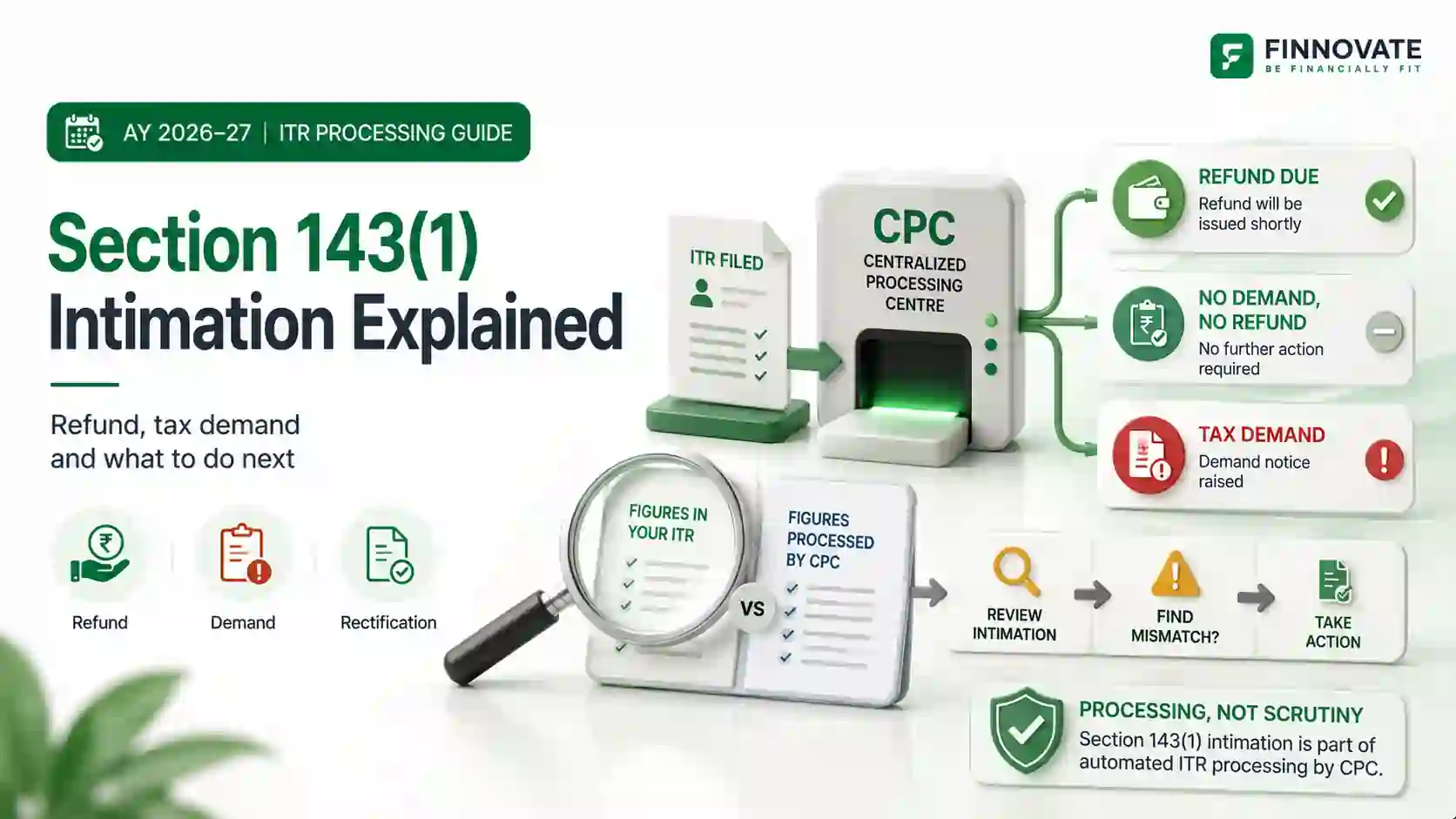
Received a Section 143(1) intimation? Understand CPC adjustments, refunds, tax demands, re...
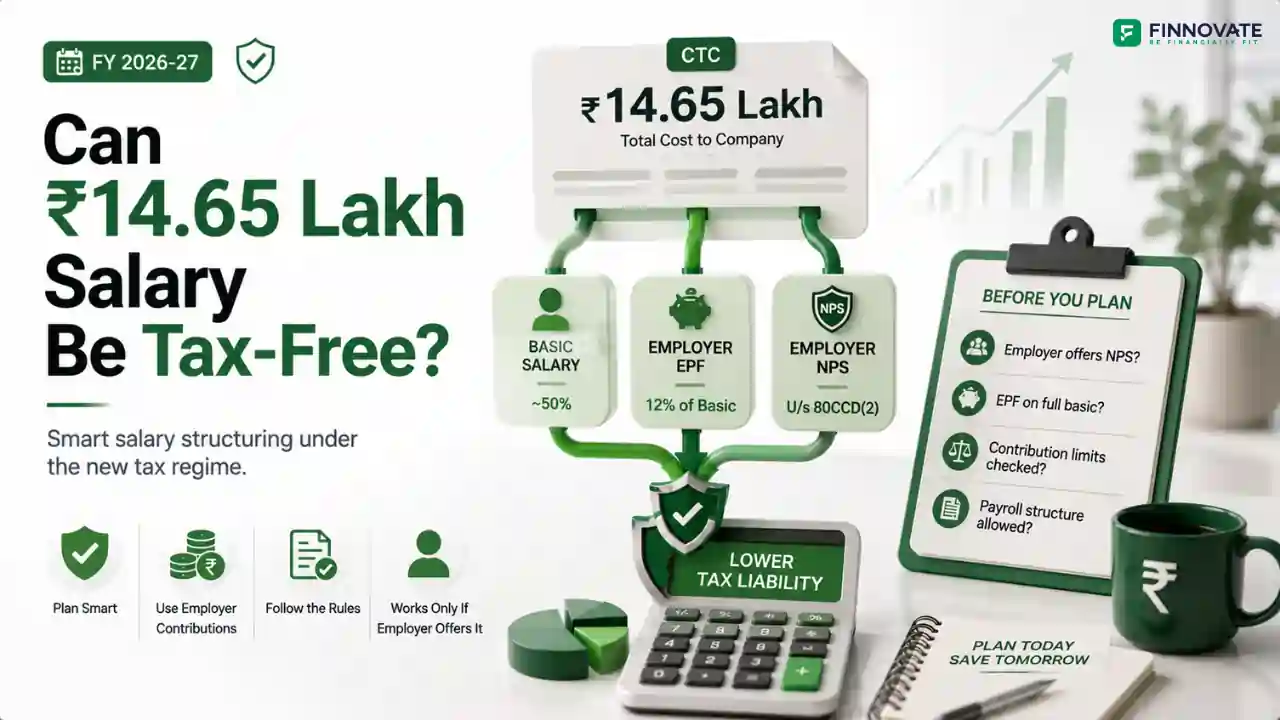
Zero tax on a ₹14.65 lakh salary is real, but only if your employer contributes EPF on f...
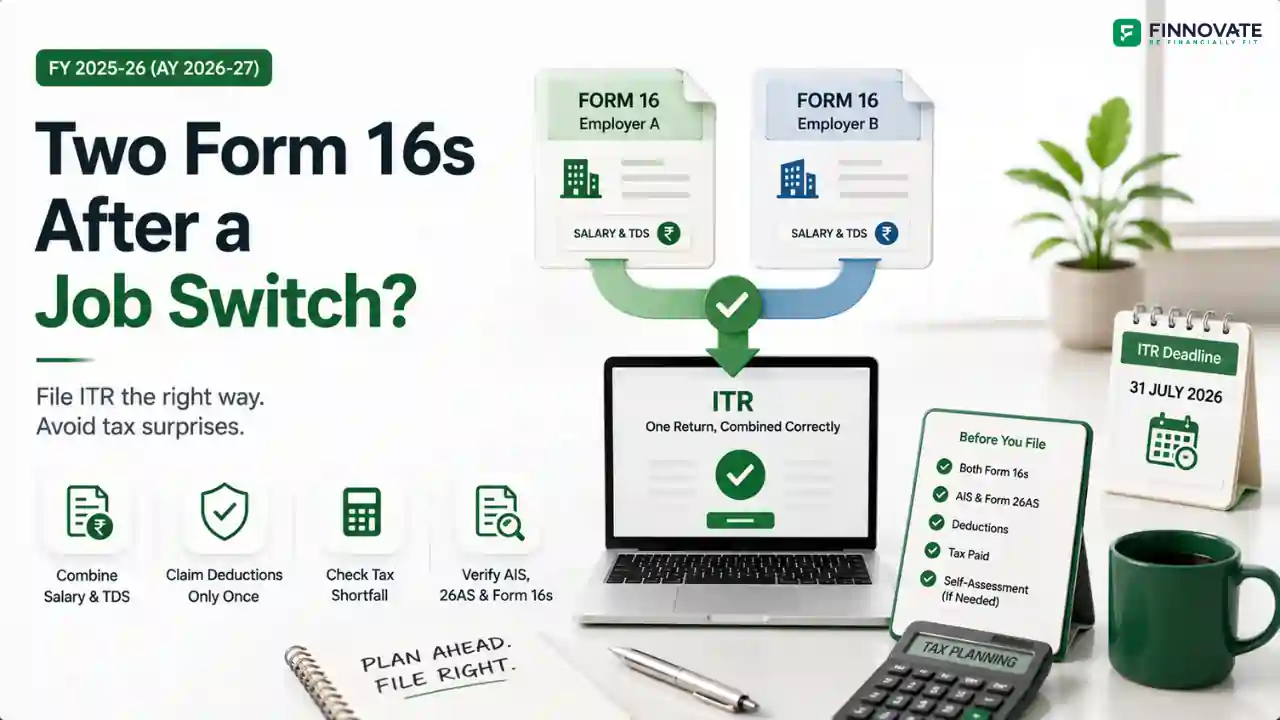
Changed jobs in FY 2025-26? See why combining two Form 16s can create a tax shortfall past...
Popular now

Learn how to easily download your NSDL CAS Statement in PDF format with our step-by-step g...

Looking for the best financial freedom books? Here’s a handpicked 2026 reading list with...
Learn what SIF investment means in India, SEBI rules, Rs 10 lakh minimum investment, avail...
Clear guide to mutual fund taxation in India for FY 2025–26 after July 2024 changes: equ...