

The Great Economic Decoupling of 2026: Oil, AI & India
Rising oil prices and booming AI investment are shaping an uneven global economy in 2026. ...
24 October 2026

India has repeatedly demonstrated its ability to capture global market shifts whether it was IT services, pharmaceuticals, BPO, or auto components. Now, the next frontier in India’s global supply chain dominance may be specialty chemicals, a fast-growing, high-value niche that offers massive headroom for growth.
The global chemicals market is currently valued at $4.7 trillion, making it one of the largest industrial sectors in the world. At present:
However, most of this is driven by commodity chemicals, which are lower-margin, high-volume products. The real growth story lies in specialty chemicals, which currently account for just 20% of global chemical volumes but offer significantly higher value-add and customer stickiness.
Specialty chemicals are performance-driven compounds used in specific applications. Unlike commodity chemicals, they are custom-formulated, often used in low volumes but priced at a premium due to their application-specific nature.
India’s $200 billion chemical sector sees specialty chemicals contributing about $36 billion (18%) - but this segment is expanding rapidly at 12%–16% CAGR, outpacing many other industrial verticals.
As global firms de-risk from over-reliance on China, India emerges as a viable alternative - politically stable, technically skilled, and relatively cost-effective.
India has scaled up research and technical capabilities, especially in formulation, green chemistry, and process optimization - crucial for specialty chemical competitiveness.
With India’s per capita chemical consumption at just 10% of the global average, there is massive headroom for internal demand growth, especially from user industries like personal care, pharma, automotive, textiles, and construction.
The Indian government is actively promoting this sector through:
India's chemical sector is clearly on the cusp of transformation but to fully capitalize, some enablers are necessary.
The government must push for dedicated chemical industrial zones with integrated logistics, R&D labs, compliance mechanisms, and world-class port infrastructure for exports.
Incentives should be linked to export targets and innovation metrics, rather than only on input usage.
Specialty chemicals require highly skilled process chemists, safety professionals, and formulation experts. The government should introduce education-industry skilling partnerships.
Delayed project approvals are a big hurdle. Clear and quick environmental norms will improve investor confidence.
FTAs (Free Trade Agreements) with key global markets like the EU, ASEAN, and the US can open up large volumes of trade in value-added chemicals.
Speak with a financial expert to explore sectoral trends and investment opportunities in India’s chemical growth story.
Book a Free ConsultationThe specialty chemicals segment is not just a sub-sector, it is a strategic economic opportunity that combines India’s strengths in manufacturing, innovation, and global diplomacy. With global buyers looking for reliable non-China alternatives, India has a once-in-a-decade window to position itself as a leader in this high-growth, high-margin industry.
Disclaimer: This article is for informational purposes only and does not constitute financial, investment, or professional advice. Readers are advised to conduct their own research or consult a qualified expert before making any investment decisions.
No spam. Only new posts, simple explainers, and practical money checklists for busy professionals.
Finnovate is a SEBI-registered financial planning firm that helps professionals bring structure and purpose to their money. Over 3,500+ families have trusted our disciplined process to plan their goals - safely, surely, and swiftly.
Our team constantly tracks market trends, policy changes, and investment opportunities like the ones featured in this Weekly Capsule - to help you make informed, confident financial decisions.
Learn more about our approach and how we work with you:
No comments yet. Start the conversation. What would you add?
No spam. Only new posts, simple explainers, and practical money checklists.
You may also like
Rising oil prices and booming AI investment are shaping an uneven global economy in 2026. ...

Explore FPI equity flows for October First Half, 2026: ₹47,955 crore in net outflows, th...
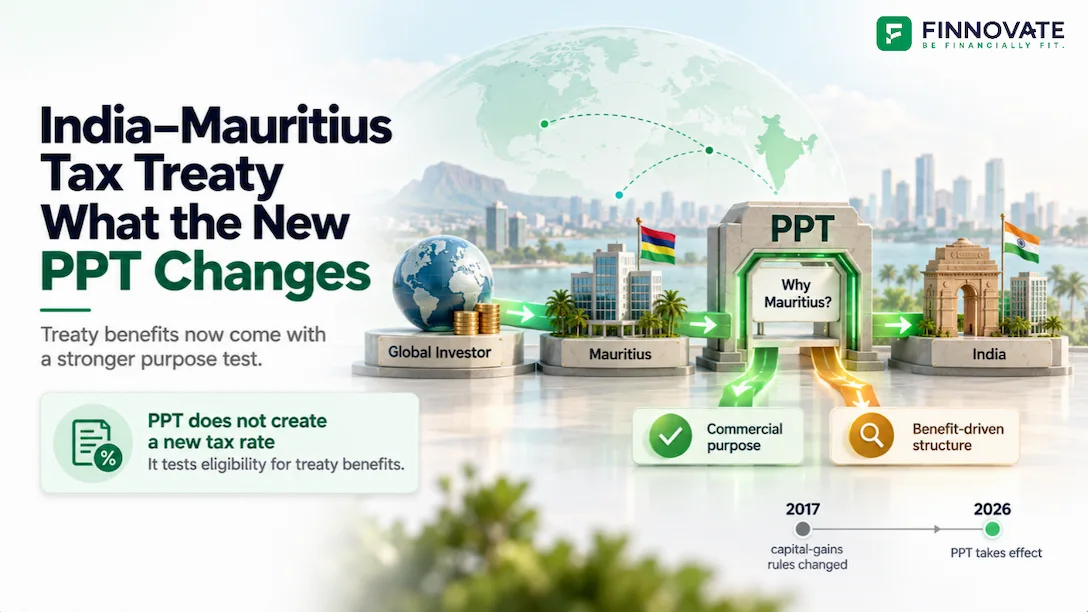
Understand the India–Mauritius tax treaty’s Principal Purpose Test, its August 2026 ef...

Explore India’s AI hardware opportunity through the proposed Adani–Jabil venture, from...
Popular now

Learn how to easily download your NSDL CAS Statement in PDF format with our step-by-step g...

Looking for the best financial freedom books? Here’s a handpicked 2026 reading list with...
Learn what SIF investment means in India, SEBI rules, Rs 10 lakh minimum investment, avail...

Clear guide to mutual fund taxation in India for FY 2025–26 after July 2024 changes: equ...