What is a Goal SIP Calculator?
A Goal SIP Calculator works backwards from the corpus you want to build. You enter your target amount, the time available and an expected return, and it estimates the monthly SIP required to get there. Finnovate's calculator can also adjust the target for inflation, account for money you have already saved, and work out a lower starting SIP that increases every year. It is the reverse of a regular SIP calculator, which starts from a monthly amount and shows the corpus. It suits goal-based financial planning.
How to Use the Goal SIP Calculator
Basic calculation
- Enter the amount required at the goal date.
- Enter the number of years available.
- Enter an expected annual return.
- Review the estimated monthly SIP and the year-by-year projection.
Advanced calculation
Turn on Advanced options to plan with more detail:
- Enter the present cost of the goal.
- Add an inflation rate so the target grows to its future cost.
- Add savings already earmarked for this goal.
- Add an annual step-up so the SIP starts lower and rises each year.
- Review the starting SIP and the future contribution schedule.
One point matters here. The target amount means different things depending on the mode. With inflation off, enter the future target directly. With inflation on, enter today's cost, and the calculator estimates the future amount for you.
What Your Goal SIP Result Means
Estimated starting monthly SIP. The amount to begin investing each month. With a step-up, this is only the year-one figure, not a flat amount.
Total amount invested. The sum of all your SIP contributions plus any existing savings you assigned to the goal.
Estimated investment growth. The difference between your total contributions and the projected corpus. This is what compounding adds.
Corpus at the goal date. The projected amount available at the end of the selected period.
Annual step-up schedule. How the monthly SIP changes each year, shown as the year-one SIP and the final-year SIP.
Goal SIP Calculator vs Regular SIP Calculator
The two tools answer different questions. A Goal SIP Calculator starts from the destination. A regular SIP calculator starts from the monthly amount.
| Question | Goal SIP Calculator | Regular SIP Calculator |
|---|---|---|
| Starting point | Target corpus | Monthly investment |
| Main output | SIP required | Future corpus |
| Best used for | A defined financial goal | Testing how a chosen SIP may grow |
| Inflation | Can be included | Often not included |
| Existing savings | Can reduce the SIP gap | Usually not considered |
How Is the Required SIP Calculated?
See the formula
For a basic month-start SIP:
Required SIP = Target corpus / future-value factor of monthly investments
Where:
- Target corpus is the amount you want at the goal date.
- Monthly rate of return is the annual return divided into monthly periods.
- Number of monthly investments is the years multiplied by twelve.
- Each contribution is assumed at the beginning of the month.
Calculation assumptions
- SIP invested at the beginning of each month.
- Return divided into equal monthly periods.
- A constant return is used throughout the period.
- Step-up applied after every twelve monthly contributions.
- Existing savings grow at the entered expected return.
- Inflation compounds annually.
- Taxes and investment costs are excluded.
Should You Adjust Your Goal for Inflation?
Enter the future target directly when you already know it. Enter today's cost and add inflation when the goal is quoted in current prices.
A course costing 20 lakh today will probably not cost 20 lakh after 12 years. Inflation adjustment first estimates its future cost, after which the calculator finds the SIP needed for that larger target.
There is no single inflation rate that fits every goal. Education, healthcare, housing and general living costs can rise at very different rates, so it is worth testing a range. For an education example, use the Child Education Plan Calculator.
How Existing Savings Reduce the SIP You Need
Money you have already saved keeps working for you, so it lowers the SIP you need now. The calculator handles it in four steps:
- Existing money continues to grow at your expected return.
- Its estimated future value is calculated.
- That future value is deducted from the goal.
- The SIP is calculated only for the remaining gap.
How a Step-Up SIP Changes the Starting Amount
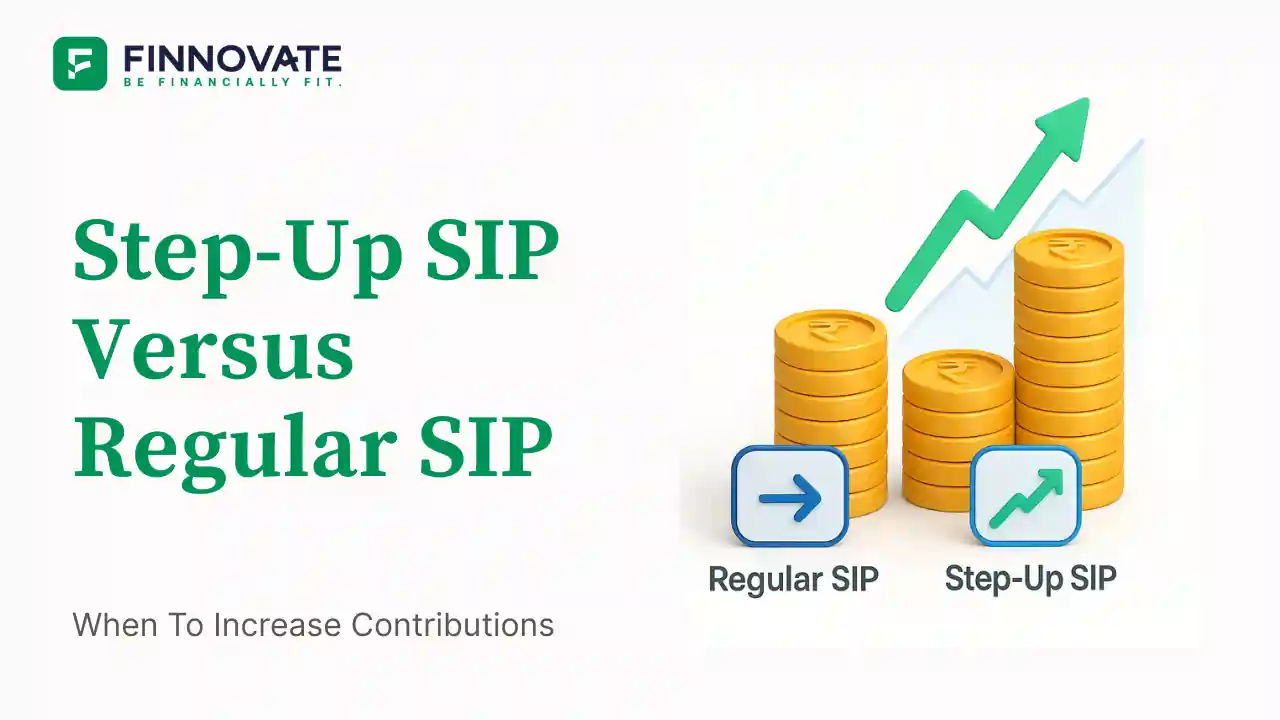
- A regular SIP stays fixed for the whole period.
- A step-up SIP increases once a year.
- Because later contributions are larger, the starting SIP can be lower.
- Future monthly commitments become higher, so plan for the rise.
A step-up does not create additional investment returns by itself. It increases the amount you contribute over time. To model it in detail, use the Step-Up SIP Calculator, or read about regular SIP versus step-up SIP.
How Much SIP Is Needed for a Target Corpus?
These figures use the same engine as the calculator above. They show the flat monthly SIP required for each target, and exclude inflation, existing savings and step-up.
| Target | Period | 8% return | 10% return | 12% return |
|---|
What to Do If the Required SIP Does Not Fit Your Budget
If the number is higher than you can invest, work through these in order:
- Check whether the goal amount is realistic.
- Extend the timeline where the goal is flexible.
- Add an affordable annual step-up.
- Allocate existing investments to the goal.
- Reduce or phase the goal.
- Reprioritise competing goals.
Use the Right Calculator for the Goal
| Goal | Recommended tool |
|---|---|
| General wealth target | Goal SIP Calculator |
| Child's higher education | Child Education Plan Calculator |
| Retirement | Retirement Calculator |
| Early financial independence | FIRE Calculator |
| Fixed monthly SIP projection | SIP Calculator |
| Increasing annual SIP | Step-Up SIP Calculator |
A Calculator Gives One Number. A Financial Plan Coordinates All Your Goals.
This calculator sizes the SIP for a single target. It cannot decide which goal should come first, the right asset allocation, your emergency-fund requirement, whether your insurance is adequate, the tax impact, whether retirement and education can both be funded, or how often the portfolio should be reviewed.
Finnovate's financial-planning service covers goal prioritisation, inflation-adjusted corpus calculation, investment strategy, insurance, taxation and coordination across goals, for professionals, families, HNIs and NRIs managing one or more goals.