What Is an ESOP Tax Calculator?
An ESOP tax calculator shows the tax when you exercise your stock options, the cash you need to do it, and the tax when you sell the shares or your company buys them back. It works for start-up, listed and foreign-parent ESOPs.
How to Use the ESOP Tax Calculator
Pick whose shares they are
Indian and not listed, Indian and listed, or a foreign company. Every rule follows from this.
Enter your exercise details
Options, exercise price, the value per share on the exercise date, and your taxable income.
Tick the start-up option if it applies
Only if your employer holds the start-up tax certificate. You will see when the deferred tax falls due.
Read your tax and cash needed
See the extra tax, and the total cash to exercise: price plus tax.
Sold or bought back? Open “2. Tax when I sell”
Choose how you sold, add the dates and prices, and the calculator applies the right rule for the date.
What Are ESOPs?
Employee stock options (ESOPs) give you the right to buy your company’s shares later, at a price fixed today. You choose when to exercise, and you pay the exercise price to get the shares.
- GrantYou get options at a fixed exercise price. No tax.
- VestYou can now exercise them. Still no tax.
- ExerciseYou pay the price and get shares. The gain is taxed as salary.
- SellOnly the rise since exercise is taxed, as a capital gain.
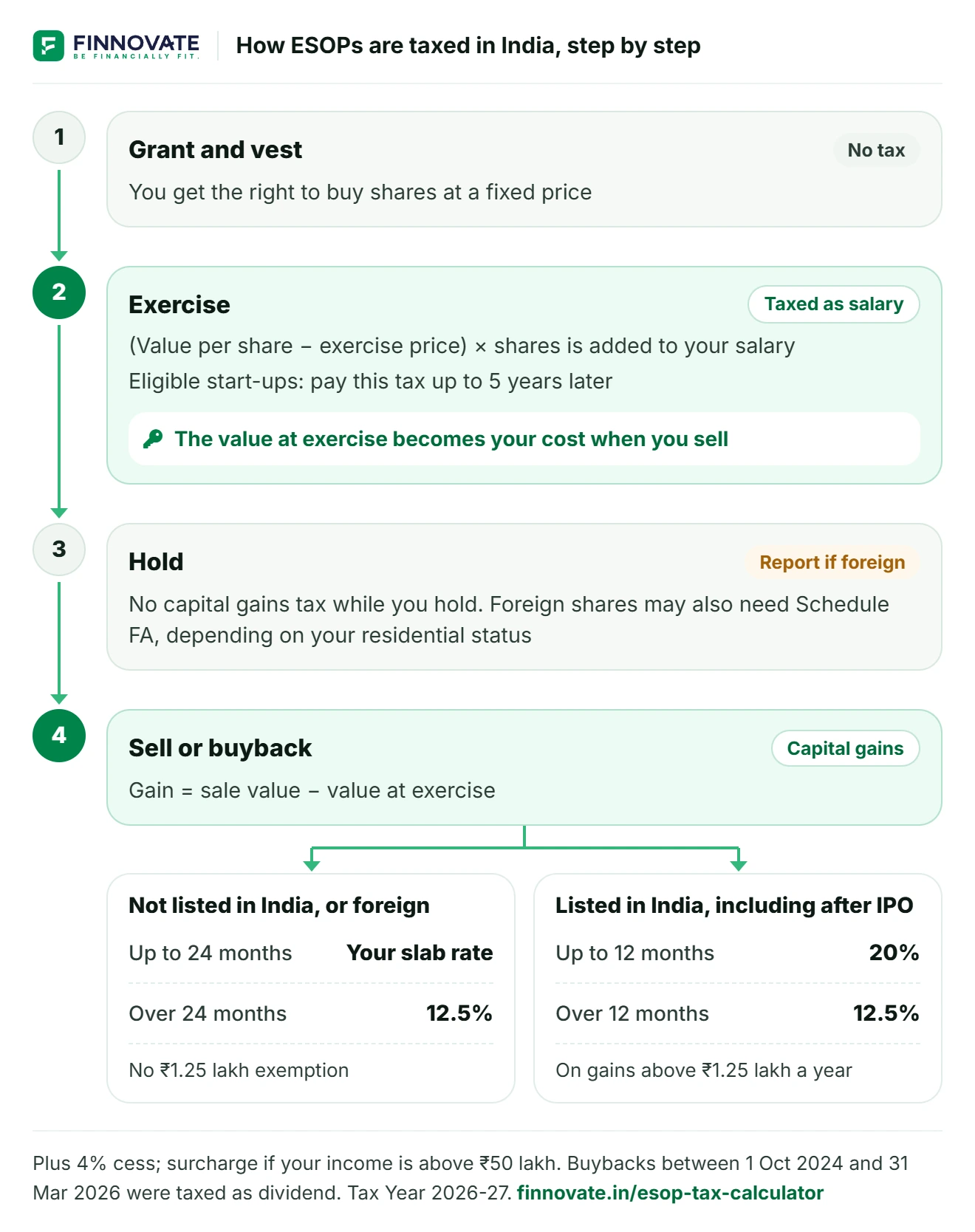
How ESOPs Are Taxed in India

-
Grant and vestNo tax
You get the right to buy shares at a fixed price
-
ExerciseTaxed as salary
(Value per share − exercise price) × shares is added to your salary
Eligible start-ups: pay this tax up to 5 years later
The value at exercise becomes your cost when you sell
-
HoldReport if foreign
No capital gains tax while you hold. Foreign shares may also need Schedule FA, depending on your residential status
-
Sell or buybackCapital gains
Gain = sale value − value at exercise
Not listed in India, or foreign
- Up to 24 months
- Your slab rate
- Over 24 months
- 12.5%
No ₹1.25 lakh exemption
Listed in India, including after IPO
- Up to 12 months
- 20%
- Over 12 months
- 12.5%
On gains above ₹1.25 lakh a year
Plus 4% cess; surcharge if your income is above ₹50 lakh. Buybacks between 1 Oct 2024 and 31 Mar 2026 were taxed as dividend. Tax Year 2026-27. finnovate.in/esop-tax-calculator
Tax at exercise: the perquisite
When you exercise, the value per share minus the exercise price, times the shares you get, is a perquisite. It is added to your salary for the tax year the shares are allotted and taxed at your slab rate, with surcharge where it applies. Under the Income-tax Act, 2025 this is section 17(1)(d), earlier 17(2)(vi). Nothing is taxed at grant or vesting, or if your options lapse.
How the value per share is set
Not listed (start-ups)
A SEBI-registered merchant banker values the shares, on the exercise date or up to 180 days before it.
Listed in India
The average of the opening and closing price on the exercise date, on the exchange with the most trading.
Foreign company
The market value your employer reports on your payslip or Form 12BA, converted to rupees.
Tax on sale: capital gains
The value at exercise becomes your cost, so you are never taxed twice on the same rupee. When you sell, the rise above that value is a capital gain, and the holding period runs from the allotment date.
| Shares | Long-term after | Long-term tax | Short-term tax |
|---|---|---|---|
| Not listed in India (start-ups) | 24 months | 12.5%, no ₹1.25 lakh exemptionSection 197 (was 112) | Your slab rate |
| Foreign company | 24 months | 12.5%, no ₹1.25 lakh exemptionSection 197 (was 112) | Your slab rate |
| Listed in India, including after IPO | 12 months | 12.5% above ₹1.25 lakh a yearSection 198 (was 112A) | 20%Section 196 (was 111A) |
Rates are before 4% cess and any surcharge. Surcharge on these capital gains is capped at 15%. Exactly 24 (or 12) months still counts as short-term.
ESOP Buyback Tax in India
Buybacks are how most start-up employees turn ESOPs into cash. The tax depends on the date of the buyback, and the rule has changed twice since 2024.
| Buyback date | How it is taxed | What you pay |
|---|---|---|
| Before 1 Oct 2024 | The company paid the buyback tax | Nothing |
| 1 Oct 2024 to 31 Mar 2026 | The full amount is a dividend; your cost becomes a capital loss | Slab rate on the whole amount, 10% TDS |
| From 1 Apr 2026 | A capital gain, on the gain only | 12.5% if held over 24 months, else slab rate |
Start-up ESOP Tax Deferral
Employees of eligible start-ups can pay the exercise tax later. The tax is still worked out at exercise, at that year’s rates; only the payment moves.
Who qualifies
Employees of a start-up holding the Inter-Ministerial Board certificate for the start-up tax benefit (section 140, earlier 80-IAC). DPIIT recognition alone is not enough. About 4,000 start-ups hold it.
When it falls due
Within 14 days of the earliest of: 60 months after the end of the tax year the shares were allotted, selling them, or leaving the company. Shares allotted in Tax Year 2026-27: by 14 April 2032 at the latest.
The 60 months replaces the earlier “48 months from the end of the assessment year”. Both land on the same date. The amount does not fall if the share price falls later.
Cash Needed to Exercise
Exercising costs money twice: the exercise price, and the tax on the gain, often before you can sell a single share. For start-up shares there may be no buyer for years.
- Listed and foreign shares: many employers offer a cashless exercise, selling some shares to pay the price and the tax.
- Start-up shares: you usually pay both from savings, unless the deferral applies.
- Leaving your job: plans often give limited time to exercise vested options, sometimes only 90 days. Check your plan before you resign.
ESOPs From a Foreign Parent Company
Options in a foreign parent follow the unlisted rules: long-term after 24 months, 12.5%, no ₹1.25 lakh exemption. Values are converted at the SBI telegraphic transfer buying rate. If you are Resident and Ordinarily Resident (ROR), foreign ESOP shares generally need to be reported in Schedule FA every year you hold them. Money sent abroad to exercise may attract 20% TCS above ₹10 lakh a year, which you can claim against your tax.
ESOP vs RSU: What’s the Difference?
| ESOP | RSU | |
|---|---|---|
| Do you pay to get shares? | Yes, the exercise price | No |
| When is salary tax due? | At exercise, when you choose | At vest, on a fixed schedule |
| Taxable amount | Value minus exercise price | Full value |
| Start-up deferral | Available if eligible | Not available |
Have RSUs instead? Use our RSU tax calculator, or read the full ESOP vs RSU taxation guide.
Common Mistakes With ESOP Tax
Using the exercise price as your cost
Your cost is the value at exercise. Using the lower price taxes the same gain twice.
Forgetting the deferral ends when you leave
Deferred tax falls due within 14 days of leaving, even if you still cannot sell.
Assuming a buyback is tax-free
Only buybacks before October 2024 were. Check the buyback date against the three rules.
Counting exactly 24 months as long-term
Long-term needs more than 24 months for unlisted and foreign shares, or more than 12 for listed.
Exercising without cash for the tax
Plan for the exercise price and the tax before you exercise, especially for shares you cannot sell.
Skipping Schedule FA for foreign shares
If you are Resident and Ordinarily Resident (ROR), foreign shares generally go in Schedule FA every year you hold them, sold or not.