What Is an RSU Tax Calculator?
An RSU tax calculator shows how much extra income tax your restricted stock units add when they vest, and the capital gains tax when you sell the shares. It works in rupees, for shares of an Indian or a foreign company.
How to Use the RSU Tax Calculator
Enter your taxable income before RSUs
Your income for the tax year after deductions, leaving out these RSUs.
Enter the RSU value from your payslip
It is shown as your RSU or perquisite value. Had more than one vest this year? Add them up.
Pick your tax regime
The new regime is the default. On the old regime, also pick your age group.
Read your extra tax
Compare your tax before and after the RSUs. Already had tax deducted? See what is left to pay.
Sold shares? Open “2. Tax when I sell”
Enter both dates, the shares sold, and the vest and sale prices from your broker statement in dollars. Check the rupee rates, then add your income that year.
What Are RSUs?
Restricted stock units (RSUs) are shares your employer promises you, usually released in parts over a few years. You pay nothing for them. Once a part vests, the shares are yours.
- GrantYour employer promises the shares. No tax.
- VestThe shares become yours. Their value is taxed as salary.
- HoldNo tax while you hold. Foreign shares go in Schedule FA every year.
- SellOnly the gain since vest is taxed, as a capital gain.
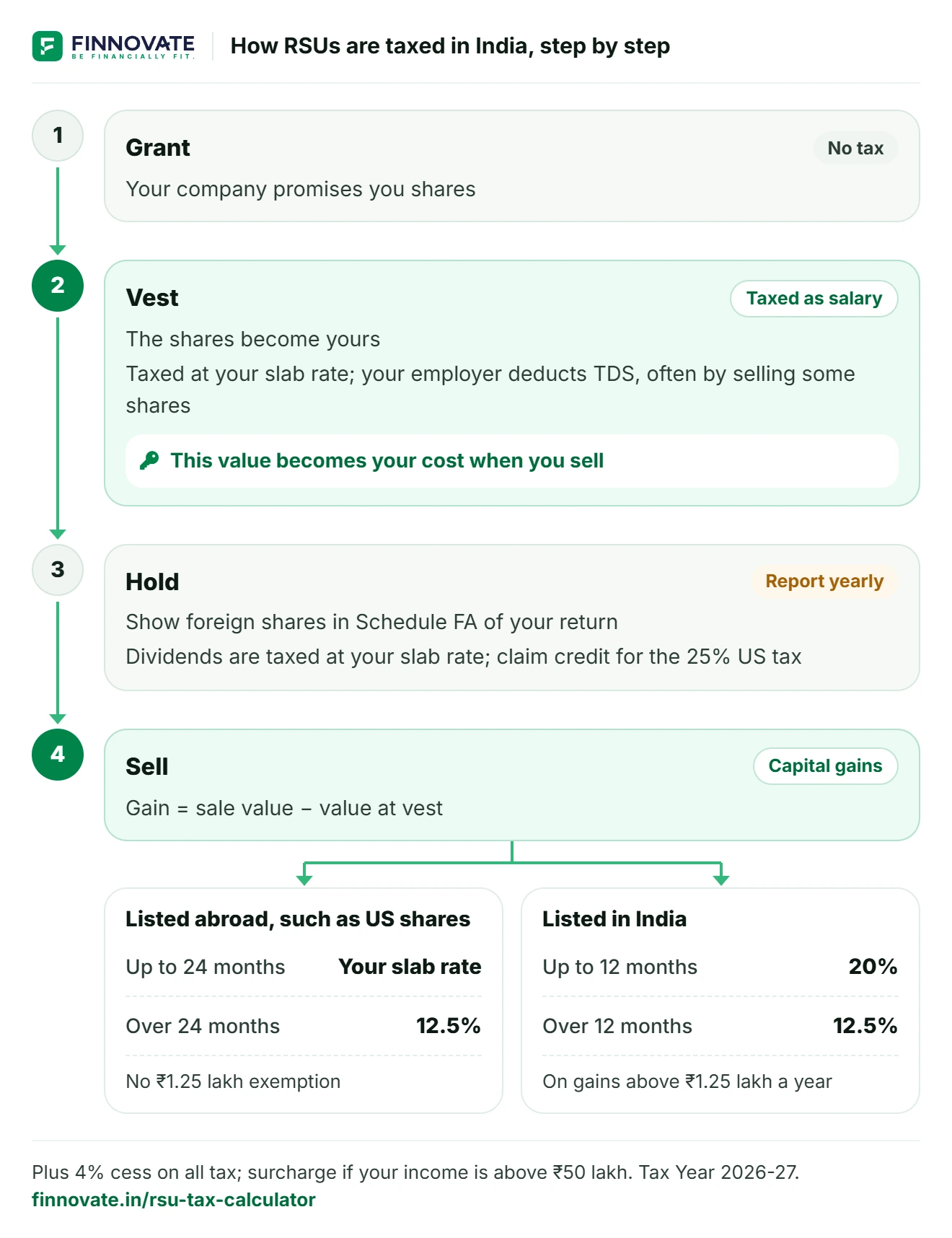
How RSUs Are Taxed in India

-
GrantNo tax
Your company promises you shares
-
VestTaxed as salary
The shares become yours
Taxed at your slab rate; your employer deducts TDS, often by selling some shares
This value becomes your cost when you sell
-
HoldReport yearly
Show foreign shares in Schedule FA of your return
Dividends are taxed at your slab rate; claim credit for the 25% US tax
-
SellCapital gains
Gain = sale value − value at vest
Listed abroad, such as US shares
- Up to 24 months
- Your slab rate
- Over 24 months
- 12.5%
No ₹1.25 lakh exemption
Listed in India
- Up to 12 months
- 20%
- Over 12 months
- 12.5%
On gains above ₹1.25 lakh a year
Plus 4% cess on all tax; surcharge if your income is above ₹50 lakh. Tax Year 2026-27. finnovate.in/rsu-tax-calculator
Tax at vest: RSUs as salary
The vest-day value (shares × price that day × rupee rate) is a perquisite, shown in Form 12BA and Form 16. Under the Income-tax Act, 2025 this is section 17(1)(d), earlier 17(2)(vi).
Tax on sale: capital gains
| Shares | Long-term after | Long-term tax | Short-term tax |
|---|---|---|---|
| Listed outside India (most RSUs) | 24 months | 12.5%, no indexation, no ₹1.25 lakh exemptionSection 197 (was 112) | Your slab rate |
| Listed in India | 12 months | 12.5% above ₹1.25 lakh a yearSection 198 (was 112A) | 20%Section 196 (was 111A) |
Rates are before 4% cess and any surcharge. Surcharge on these capital gains is capped at 15%.
Converting dollars to rupees
Foreign amounts are converted at the SBI telegraphic transfer (TT) buying rate on the last day of the month before the month the RSUs vest, for salary, or the month you sell, for capital gains (Rule 206 of the Income-tax Rules, 2026, earlier Rule 115).
Sell-to-Cover and TDS on RSUs
Your employer must deduct tax on the RSU value at vest, as it does on salary (section 392, earlier 192). Most employers sell or hold back some of the vested shares to pay it, called sell-to-cover; some deduct it from your salary instead.
Check your payslip
The RSU value and the tax deducted on it appear on your payslip and in Form 12BA and Form 16.
Still to pay
If the deduction is less than your tax, often because the RSUs push you into a higher slab, pay the difference as advance or self-assessment tax.
RSU Dividends and the Foreign Tax Credit
Dividends on US shares are taxed in India at your slab rate. The US first keeps 25% under the India–US tax treaty (30% if you have not filed Form W-8BEN). You can claim the US tax as a credit, up to the Indian tax on that dividend.
- Form 44: claim the credit with Form 44 (it replaced Form 67) within 12 months from the end of the tax year
- Earlier years: income up to Tax Year 2025-26 still uses Form 67
- Large credits: an accountant must verify the form if foreign tax is ₹1 lakh or more
Reporting RSUs in Your Income Tax Return
With RSU income, capital gains or foreign shares, you usually file ITR-2. Three parts of it matter for RSUs.
Schedule FA
List foreign shares you held at any time in the calendar year, January to December, even if you have not sold them.
Schedules FSI and TR
Report foreign income such as dividends, and the foreign tax you are claiming as a credit.
Penalty for missing it
Not disclosing foreign assets can attract a ₹10 lakh penalty under the Black Money Act. There is no penalty if your foreign assets, other than property, total ₹20 lakh or less.
Source: Income Tax Department, Income-tax Act, 2025 and Income-tax Rules, 2026.
RSU vs ESOP: What’s the Difference?
| RSU | ESOP | |
|---|---|---|
| How you get the shares | Free, when they vest | You buy them at an exercise price |
| Taxed as salary | Full value at vest | Value minus exercise price, at exercise |
| On sale | Capital gain on the rise since vest | Capital gain on the rise since exercise |
| Tax deferral | Not available | Available for eligible start-ups |
Read our full comparison of ESOP vs RSU taxation in India.
Common Mistakes With RSU Tax
Selling just before 24 months
A short-term gain on foreign shares is taxed at your slab rate, often 30%, against 12.5% a little later.
Assuming TDS covered it all
Sell-to-cover often withholds less than the tax at your top slab.
Paying tax twice on the same value
Your cost on sale is the value already taxed at vest.
Skipping Schedule FA
Foreign shares must be reported every year, sold or not.
Using the wrong rupee rate
Use the SBI TT buying rate for the month before, not the rate on the day.
Not claiming the US tax credit
File Form 44 (earlier Form 67) to claim back US tax on dividends.